Choosing the right PPI for an aluminum ceramic foam filter means balancing inclusion capture with molten aluminum flow. A higher PPI generally indicates a finer nominal pore structure, but it can also increase flow resistance. For many general aluminum casting applications, 30 PPI is a practical starting point. Lower grades may be considered when flow capacity is a priority, while 40–60 PPI grades are evaluated for applications requiring finer filtration. The best choice depends on the required metal cleanliness and actual casting conditions.
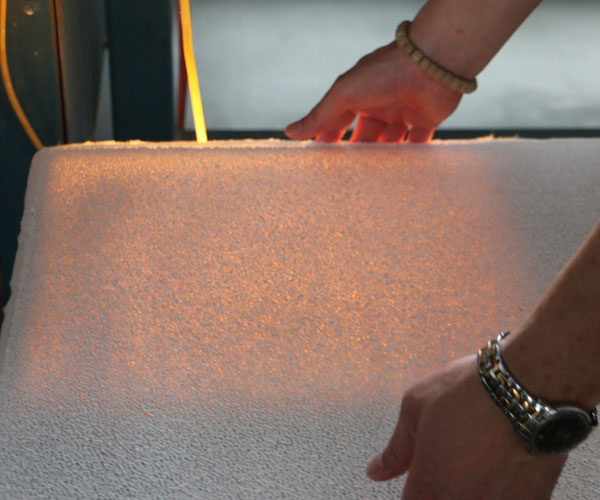
Aluminum Filtration-Ceramic Foam Filters
What Does PPI Mean in a Ceramic Foam Filter?
PPI stands for pores per inch. It is a nominal rating used to describe the pore density of a ceramic foam filter.
For example, a 30 PPI filter has a nominal pore density of approximately 30 pores per linear inch. A 40 PPI filter has a higher nominal pore density and generally a finer pore structure.
However, PPI should not be interpreted as an exact pore diameter or a guaranteed particle-removal size. The actual openings between ceramic struts, pore uniformity, and filter permeability also affect filtration performance.
This distinction matters when comparing filters. Two products carrying the same PPI rating may not have identical pore structures or flow characteristics.
How Does PPI Affect Filtration and Metal Flow?
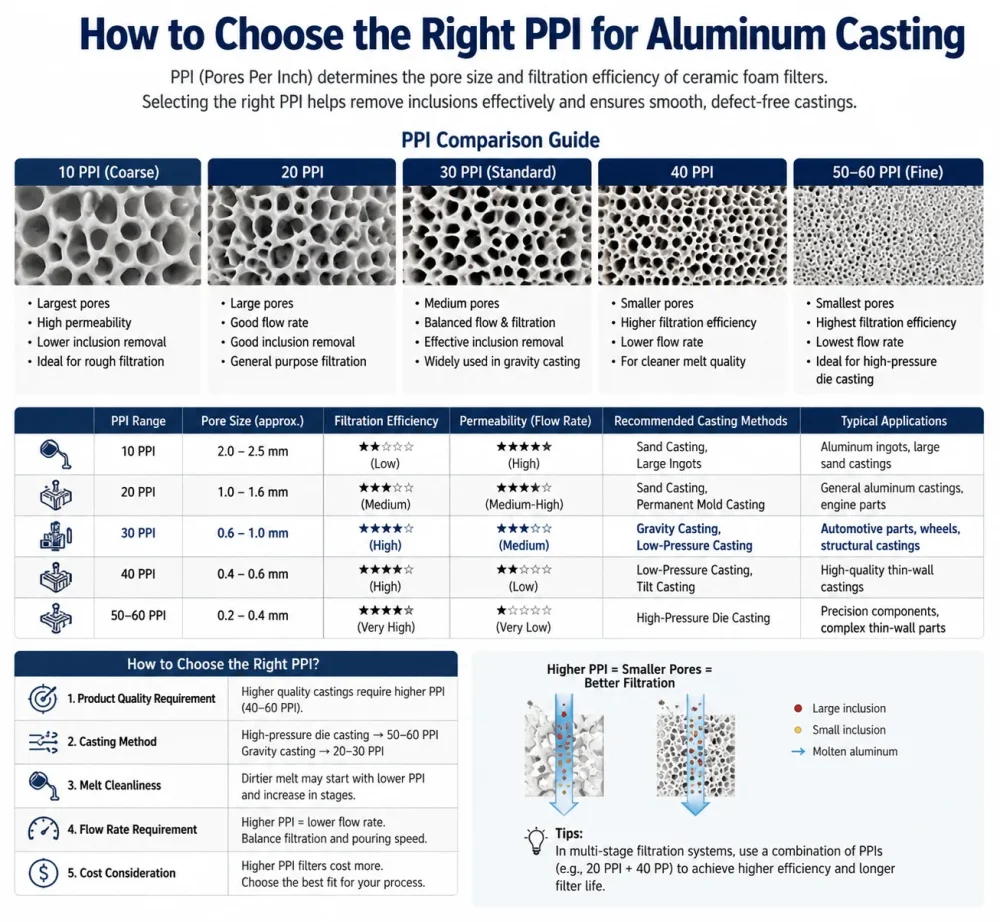
how to choose cff for aluminum casting
The main consideration when selecting PPI is the relationship between filtration precision and flow resistance.
As PPI increases, the nominal pore structure generally becomes finer. This provides more opportunities to capture smaller inclusions, but it may also make it harder for molten aluminum to pass through the filter.
| PPI Selection | General Pore Structure | Filtration Consideration | Flow Consideration |
|---|---|---|---|
| 10 PPI | Very open | More suitable for relatively coarse inclusion capture | Higher flow capacity |
| 20 PPI | Open | Balances coarse inclusion capture with metal throughput | Relatively low flow resistance |
| 30 PPI | Orta | General-purpose filtration | Practical balance between filtration and flow |
| 40 PPI | Finer | Consider when more demanding inclusion control is required | Flow performance needs validation |
| 50 PPI | Fine | For applications requiring finer filtration | Greater attention to flow resistance |
| 60 PPI | Very fine | Specialized filtration requirements | Requires careful flow and capacity evaluation |
These are general selection characteristics, not fixed performance guarantees. Actual results depend on the filter’s physical structure, permeability, filtration area, and operating conditions.
Which PPI Is Suitable for Your Aluminum Casting Application?
The following grades provide a practical starting point for evaluating different filtration requirements.
10–20 PPI: When Metal Flow Capacity Is a Priority
A 10 or 20 PPI ceramic foam filter has a relatively open pore structure. These grades can be considered when the casting process requires higher metal throughput or when the main filtration target is relatively coarse inclusions.
They may be worth evaluating when:
- The casting process requires a relatively high metal flow rate.
- The available metal head is limited.
- A more open filter structure is preferred to maintain throughput.
- Extremely fine filtration is not the primary requirement.
However, a more open pore structure does not provide the same filtration characteristics as a finer grade. If the finished product has demanding inclusion limits, a lower PPI should not be selected solely to achieve higher flow.
30 PPI: A Practical Starting Point for General Aluminum Casting
30 PPI is a commonly used grade for general aluminum casting applications. It offers a practical balance between inclusion capture and metal flow.
It is a reasonable starting point when:
- The production process requires routine molten aluminum filtration.
- The existing casting line operates satisfactorily with a medium-grade filter.
- Both metal throughput and inclusion control are important.
- There is no confirmed production requirement for a finer filtration grade.
For foundries unsure whether to use 20 or 40 PPI, starting with 30 PPI and evaluating actual casting results can provide a useful reference.
40–50 PPI: When Finer Filtration Is Required
40 and 50 PPI filters have finer nominal pore structures than 30 PPI filters. They can be considered when the casting process requires more demanding control of non-metallic inclusions.
Typical evaluation conditions include:
- Higher internal cleanliness requirements.
- Production of higher-quality billet or rolling slab.
- Applications where existing filtration results indicate a need for finer inclusion control.
- Processes with sufficient filtration capacity to accommodate the selected grade.
Moving from 30 to 40 or 50 PPI should not be an automatic upgrade. A finer filter may increase flow resistance and reduce throughput if the filtration area and available metal head are insufficient.
The objective is to improve inclusion control without disrupting the required casting flow.
60 PPI: For Specialized Fine-Filtration Requirements
60 PPI is a finer grade intended for applications with more demanding filtration requirements.
It should be considered only when the required metal cleanliness justifies the finer pore structure and the casting system can maintain an acceptable flow rate.
Before selecting 60 PPI, evaluate the filter’s actual permeability and its performance under the intended operating conditions. A higher PPI rating alone does not guarantee better final casting quality.
Should You Always Choose a Higher PPI?
No. A higher PPI is not automatically a better choice.
Consider a foundry currently using 30 PPI filters. If metal flow is stable and the required casting cleanliness is achieved, changing to 50 PPI may provide no practical benefit.
If the production team changes to a finer filter without checking flow capacity, the result may include:
- Increased resistance to molten metal flow.
- Slower filling or reduced casting throughput.
- Higher sensitivity to inclusion loading.
- Premature flow restriction under unfavorable operating conditions.
On the other hand, choosing a filter that is too open may allow more inclusions to pass through than the casting process can tolerate.
The correct PPI is therefore the grade that meets the required cleanliness while maintaining stable metal flow, not simply the highest number available.
How Can You Confirm the Right PPI Before Bulk Purchasing?
A practical way to confirm PPI selection is to compare filter grades under controlled production conditions.
For example, when evaluating a change from 30 to 40 PPI:
- Keep the alloy, casting conditions, and filter dimensions as consistent as possible.
- Record the existing filter’s metal flow behavior and production results.
- Test the alternative PPI under comparable conditions.
- Compare casting cleanliness, flow stability, and any change in filter loading.
- Confirm that the finer grade provides a meaningful benefit without affecting production throughput.
Avoid changing several major process variables at the same time. Otherwise, it becomes difficult to determine whether the difference comes from PPI, filter area, metal flow, or another operating condition.
For critical applications, inclusion analysis and metallurgical inspection provide more reliable evidence than visual appearance alone.
AdTech Ceramic Foam Filters: Available PPI Grades
AdTech supplies alumina ceramic foam filters in multiple PPI grades, including 10, 20, 30, 40, 50, and 60 PPI.
Different grades are available for different filtration requirements, from relatively open structures prioritizing metal flow to finer structures for applications requiring improved inclusion control.
When recommending a PPI grade, we consider the customer’s current filter specification and production requirements rather than selecting a product based only on the highest available PPI.
If you are currently using another filter brand, you can share its PPI rating, dimensions, and application with our team. We can assess a comparable AdTech specification and discuss suitable samples for production evaluation.
Choosing the correct PPI is the first step. The next step is to make sure the filter’s dimensions, effective filtration area, and other specifications are suitable for the casting line. Read our guide on How to Match Ceramic Foam Filter Specifications with Casting Requirements for a closer look at these factors.
Sık Sorulan Sorular
1.What does PPI mean in an aluminum ceramic foam filter?
PPI stands for pores per inch and indicates the nominal pore density of a ceramic foam filter. A 30 PPI filter has a nominally more open pore structure than a 40 PPI filter, while a 40 PPI filter generally has finer pores. PPI is a classification rating, not an exact measurement of pore diameter.
2.Is ceramic foam filter PPI the same as micron filtration rating?
No. PPI and micron ratings describe different characteristics. PPI indicates nominal pore density, while a micron rating refers to a particle size or filtration rating. There is no universal conversion between PPI and microns because actual pore openings and filtration behavior also depend on the filter structure and manufacturing process.
3.Does a higher PPI ceramic foam filter remove more inclusions?
A higher PPI generally provides a finer pore structure and may improve the capture of smaller inclusions. However, actual filtration performance also depends on pore geometry, permeability, inclusion loading, and operating conditions. A higher PPI does not automatically guarantee cleaner castings.
4.What is the difference between 20 PPI, 30 PPI, and 40 PPI ceramic foam filters?
A 20 PPI filter generally has a more open pore structure and may offer lower flow resistance. A 30 PPI filter provides a practical balance between inclusion capture and metal flow for many general applications. A 40 PPI filter has a finer nominal pore structure and may be considered when more demanding inclusion control is required, provided the casting system can maintain sufficient metal flow.
5.Which PPI is recommended for general aluminum casting?
30 PPI is a practical starting point for many general aluminum casting applications because it offers a balance between filtration and flow capacity. However, the final selection should consider the required metal cleanliness, alloy, casting process, and existing production results rather than relying on a general recommendation alone.
6.Should I use a higher PPI filter for aluminum billet, slab, or foil stock production?
Not necessarily. Billet, slab, and foil stock production may have different inclusion-control requirements, but the product type alone does not determine the correct PPI. The required metal cleanliness, casting speed, filtration capacity, and available metal head should all be considered before selecting a finer grade.
7.Does a higher PPI ceramic foam filter reduce molten aluminum flow rate?
It may. A finer pore structure can increase flow resistance, particularly when filtration area and other operating conditions remain unchanged. If metal throughput decreases after switching to a higher PPI, check filter permeability, effective filtration area, available metal head, and inclusion loading before concluding that PPI is the only cause.
8.Why do ceramic foam filters with the same PPI from different manufacturers perform differently?
The same nominal PPI does not guarantee identical pore structures or filtration characteristics. Different manufacturers may use different foam carriers, ceramic formulations, pore geometries, and manufacturing processes. These differences can affect actual pore openings, pore uniformity, permeability, and molten aluminum flow behavior.
9.Can I replace my existing 30 PPI ceramic foam filter with a 40 PPI filter directly?
Not without checking its suitability for your production conditions. A 40 PPI filter may offer a finer pore structure, but it can also increase flow resistance. Before changing grades, compare the existing filter specifications and evaluate the new grade under comparable casting conditions to confirm that metal flow and casting quality remain acceptable.
10.How can I select and test the right ceramic foam filter PPI before bulk purchasing?
Start with your current filter brand, PPI, dimensions, alloy, casting application, and required metal flow rate. Compare samples of the proposed grade under consistent production conditions, recording metal flow behavior, filtration stability, and casting cleanliness. This helps determine whether the new PPI provides a meaningful improvement before placing a bulk order. AdTech can assess your existing filter specifications and discuss suitable samples for production testing.