Selecting a refractory lining for a high-magnesium aluminum degassing box requires more than checking its maximum service temperature. Magnesium can react with susceptible silica-bearing refractory phases, while molten alloy penetration, thermal cycling, and reaction-induced cracking can accelerate lining deterioration. The right material should be evaluated for chemical compatibility, porosity, resistance to molten aluminum penetration, structural integrity, and performance under the actual operating conditions.
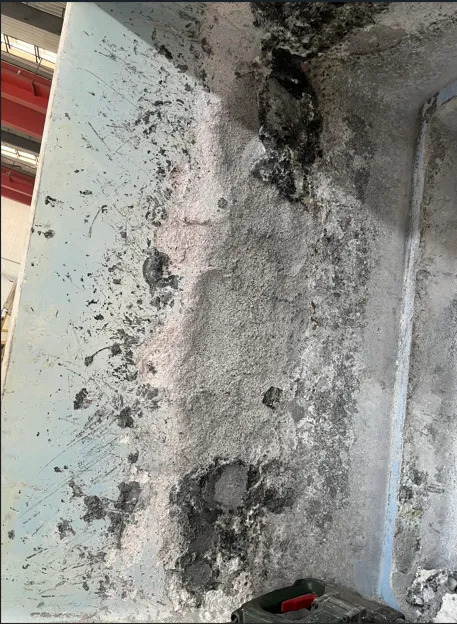
Refractory lining deterioration associated with high-magnesium aluminum alloy processing.
What Should You Consider When Selecting a Degassing Box Lining?
A refractory lining used in aluminum melt treatment must withstand sustained contact with molten metal, repeated heating and cooling, and the operating conditions created by degassing equipment. When processing high-magnesium alloys, chemical compatibility becomes especially important.
A lining that performs adequately in a conventional aluminum alloy may not provide the same service life in an Al–Mg melt. Magnesium changes the chemical environment at the metal–refractory interface, making the composition and microstructure of the lining important selection criteria.
Before specifying a material, evaluate the following properties:
| Selection criterion | Why it matters | What to verify |
|---|---|---|
| Chemical compatibility | Magnesium can react with certain refractory phases | Compatibility with the actual alloy composition |
| Porosity | Connected pores can allow molten alloy to penetrate the lining | Open porosity, pore connectivity, and density |
| Wetting resistance | Greater metal wetting can facilitate interfacial contact and penetration | Behavior in contact with the intended molten alloy |
| Thermal stability | Repeated temperature changes can promote cracking | Thermal cycling resistance and dimensional stability |
| Mechanical integrity | Cracks and weak surface layers can accelerate material loss | Strength, bonding, and resistance to spalling |
| Service durability | Corrosion and erosion can occur simultaneously | Performance under representative operating conditions |
No individual property is sufficient to predict service life. A dense material may still react chemically with the alloy, while a chemically resistant composition may deteriorate if it cannot withstand thermal shock or mechanical loading.
Which Refractory Materials Are Suitable for High-Magnesium Aluminum?
Refractory materials used in aluminum processing vary in oxide composition, phase structure, porosity, and resistance to molten metal. Silica-bearing and aluminosilicate materials should be evaluated carefully when exposed to high-magnesium alloys because their constituent phases may participate in corrosion reactions.
Magnesia-, alumina-, and spinel-based materials may be considered in certain refractory applications, but no material family should be assumed suitable solely because of its name. The finished formulation, microstructure, installation method, and operating environment determine actual performance.
| Material characteristic | Potential benefit | Limitation to evaluate |
|---|---|---|
| Silica-bearing refractory | May offer useful thermal and dimensional properties in suitable applications | Susceptibility to reaction with aluminum-magnesium melts |
| Alumina-rich refractory | Can provide useful high-temperature stability | Compatibility with magnesium-containing melts must still be established |
| Spinel-containing refractory | May be suitable for specific demanding refractory applications | Phase stability and resistance to the actual melt environment require verification |
| Low-porosity refractory | Can reduce pathways for molten metal penetration | Low porosity alone does not eliminate chemical attack |
| Non-wetting refractory formulation | May reduce direct contact or infiltration under suitable conditions | Performance depends on the formulation and test conditions |
The important distinction is between the performance of a raw material and that of a finished refractory lining. Aggregate selection, bonding phases, additives, manufacturing conditions, and installation quality all affect the final material.
For this reason, supplier specifications should identify the complete refractory formulation or relevant performance characteristics rather than relying exclusively on a generic material designation.
Why Is Porosity Important in Aluminum Degassing Box Linings?
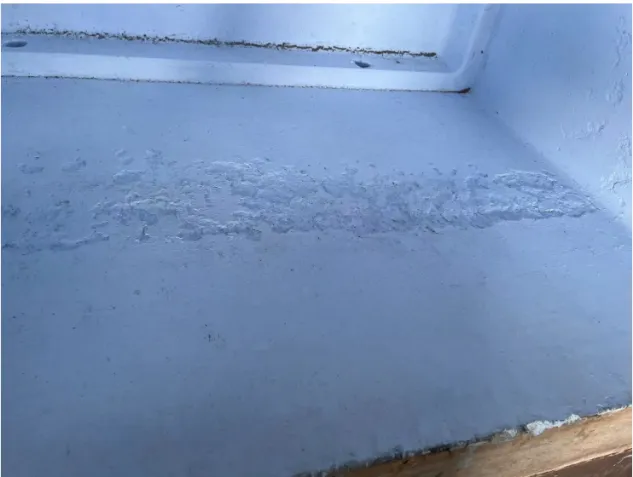
Refractory lining deterioration associated with high-magnesium aluminum alloy processing.
Porosity affects how molten aluminum interacts with the lining. Open, interconnected pores and existing microcracks can provide pathways through which molten alloy penetrates the refractory structure.
Once the metal enters the lining, it can react with susceptible phases below the original hot face. This means that visible surface condition alone may not reveal the full extent of deterioration.
Porosity should therefore be evaluated alongside chemical compatibility and mechanical strength.
| Property | Potential effect on lining performance | Assessment approach |
|---|---|---|
| Open porosity | Influences access to connected internal pore networks | Open-porosity measurement |
| Bulk density | Provides information about material compactness | Density measurement |
| Pore connectivity | Determines whether pores form penetration pathways | Microstructural examination |
| Existing cracks | Can allow localized deep metal penetration | Visual inspection and microscopy |
| Surface integrity | Affects the initial metal–refractory interface | Surface inspection and material testing |
Lower open porosity can help restrict penetration, but it is not a universal solution. Chemical reactions may still occur at the exposed surface, and thermal stress can create new cracks during operation.
The goal is to select a lining with a suitable combination of density, chemical resistance, and structural stability under the intended service conditions.
How Can Refractory Corrosion Resistance Be Tested?
Material selection should ideally be supported by tests that reproduce the important aspects of the intended operating environment.
A refractory tested against commercially pure aluminum may behave differently when exposed to an aluminum alloy containing significant magnesium. The test alloy, temperature, exposure duration, specimen preparation, and evaluation method must therefore be considered when interpreting test results.
One relevant research approach is the Alcan immersion test, which has been used to assess aluminosilicate refractory corrosion in contact with molten Al–Mg alloys. A peer-reviewed review published in Materials examined the effects of refractory composition and non-wetting additives under controlled exposure conditions. Its results demonstrate why compatibility should be tested for the specific material formulation rather than inferred from a broad material category.
| Evaluation method | What it can reveal | Important limitation |
|---|---|---|
| Molten alloy immersion test | Overall resistance to attack under defined conditions | Results may not reproduce every production condition |
| X-ray diffraction (XRD) | Crystalline phases formed or consumed during exposure | Does not independently explain the entire corrosion mechanism |
| SEM with EDS analysis | Microcracks, penetration profiles, and local elemental distribution | Requires representative samples and careful interpretation |
| Porosity and density testing | Physical characteristics related to penetration | Cannot establish chemical compatibility by itself |
| Thermal cycling test | Stability during repeated heating and cooling | Must reflect relevant temperature ranges and cycle conditions |
Published tests can provide valuable evidence, but a successful laboratory result should not be treated as a universal performance guarantee. The refractory must still be evaluated against the actual alloy chemistry, degassing box design, and service conditions.
How Do Non-Wetting Additives Affect Refractory Performance?
Some refractory formulations incorporate non-wetting additives intended to reduce the tendency of molten aluminum alloys to wet or penetrate the material. These formulations aim to improve the behavior of the metal–refractory interface, although their effectiveness depends on composition and operating conditions.
Research on aluminosilicate refractories exposed to molten Al–Mg alloys has shown that different additives can produce different results. In the 2020 study cited above, the tested white-fused-mullite formulation containing a combination of calcium fluoride and barium sulfate showed better resistance to cracking under the reported test conditions than samples containing the individual additives alone.
This finding should not be interpreted as a universal recipe for commercial degassing box linings. It illustrates a more important selection principle: the performance of a refractory depends on the complete formulation and the interaction between its constituents, not merely on the presence of one additive.
When reviewing a refractory with non-wetting additives, buyers should establish:
- Whether corrosion testing used a representative Al–Mg alloy.
- Whether the test temperature and exposure duration are relevant to the intended application.
- Whether resistance to penetration and cracking was actually evaluated.
- Whether the finished material maintains adequate mechanical and thermal properties.
- Whether the supplier can provide supporting test results or service data relevant to the application.
A material modification that improves wetting resistance but compromises structural integrity may not deliver the desired operational benefit.
What Operating Conditions Affect Degassing Box Lining Life?
Even a suitably selected refractory can fail prematurely if operating conditions are poorly controlled. Thermal cycling, local metal movement, cleaning practices, installation defects, and chemical exposure can all contribute to lining deterioration.
For high-magnesium alloys, these factors should be evaluated together rather than treating every failure as a material-selection problem.
| Operating factor | Possible damage mechanism | Practical control consideration |
|---|---|---|
| Alloy magnesium content | Changes the chemical compatibility requirements | Select and validate the refractory for the actual alloy range |
| Operating temperature | Influences reaction rates and thermal stresses | Follow the specified temperature limits |
| Preheating and startup | Affects thermal gradients and initial stress | Use an appropriate, controlled preheating procedure |
| Repeated shutdowns | Introduces additional thermal cycles | Review startup and shutdown practices |
| Mechanical cleaning | Can damage the exposed lining or initiate cracks | Use suitable tools and maintenance procedures |
| Melt flow and turbulence | May contribute to local erosion and interface disturbance | Review equipment geometry and operating conditions |
| Lining installation | Poor joints or unsuitable installation can create weak points | Verify workmanship and installation specifications |
The location and pattern of damage can help distinguish between chemical attack, thermal shock, and mechanical erosion. For recurring failures, examination of used lining material and comparison with the operating history can be more useful than simply increasing the nominal service-temperature rating of the replacement material.
How Can You Reduce Refractory Replacement Costs?
The cost of a degassing box lining is not limited to the purchase price of the refractory. Replacement labor, production interruptions, installation work, and the risk of contamination from degraded lining material may also affect total operating cost.
A lower-priced lining that requires frequent replacement may be more expensive over its service life than a more suitable material with a higher initial cost.
A practical evaluation should compare materials under equivalent conditions.
| Cost consideration | What to assess |
|---|---|
| Initial material cost | Purchase price for the required lining specification |
| Installation cost | Labor, preparation, and installation requirements |
| Service life | Documented operating history under comparable alloy conditions |
| Downtime | Production lost during inspection, repair, or replacement |
| Maintenance frequency | Required inspection and repair intervals |
| Failure consequences | Risk of unplanned shutdown or refractory contamination |
Service-life comparisons are meaningful only when the alloy, operating temperature, equipment design, maintenance procedure, and failure criteria are reasonably comparable. A reported service life from a different application should not be used as a direct guarantee for a high-magnesium aluminum degassing box.
What Should You Ask a Refractory Supplier Before Purchasing?
A technically useful purchasing specification should describe the operating environment and the required performance, not just the product name.
Before approving a refractory for high-magnesium aluminum service, confirm the following with the supplier:
- What alloy composition and magnesium range has the material been evaluated against?
- What is the specified operating-temperature range?
- Is there test evidence for resistance to molten Al–Mg attack?
- Have penetration, cracking, and reaction-product formation been assessed?
- What preheating, installation, and maintenance procedures are required?
- Are technical data and inspection records available for the proposed formulation?
- Has the material demonstrated satisfactory service in a comparable application?
Where premature corrosion has already occurred, providing photographs, the alloy specification, operating temperatures, and the observed failure pattern can help narrow down the likely causes. A sample of the used refractory may provide further evidence when laboratory analysis is available.
The final choice should be based on a documented match between the material and the service conditions. For high-magnesium aluminum, chemical compatibility, penetration resistance, and structural durability deserve particular attention alongside conventional thermal properties.
Selecting a Refractory Lining for Long-Term Degassing Box Performance
A durable lining for high-magnesium aluminum processing must withstand a combination of chemical attack, metal penetration, and operational stress. Maximum service temperature alone is not a sufficient selection criterion.
The most reliable approach is to assess refractory composition, porosity, wetting behavior, phase stability, and thermal durability against the actual alloy and equipment conditions. Where corrosion occurs repeatedly, material examination and representative testing can help distinguish between an unsuitable formulation and problems associated with installation or operation.
For aluminum producers, this evaluation provides a stronger technical basis for selecting replacement materials, reducing unplanned maintenance, and improving the reliability of degassing equipment.
FAQ
1. What refractory lining is suitable for high-magnesium aluminum alloys?
The lining should be selected based on its chemical compatibility with the Al–Mg alloy, resistance to molten metal penetration, porosity, and thermal stability. Suitability should be verified under representative operating conditions.
2. Why do high-magnesium aluminum alloys attack refractory linings?
Magnesium can react with susceptible silica-bearing refractory phases. Combined with molten metal penetration and thermal stress, these reactions can weaken the lining and promote cracking or spalling.
3. Are silica-containing refractories suitable for high-magnesium aluminum?
Not all silica-containing refractories are suitable. Magnesium can react with silica-bearing phases, so the complete refractory formulation must be evaluated for the intended alloy and operating conditions.
4. How does porosity affect refractory corrosion resistance?
Connected pores and microcracks can provide pathways for molten aluminum to penetrate the lining. Lower open porosity may help reduce penetration, but it does not eliminate chemical attack.
5. What is the role of magnesium aluminate spinel in refractory damage?
Magnesium aluminate spinel (MgAl₂O₄) can form during reactions between magnesium-containing melts and alumina-bearing materials. Depending on the refractory structure, reaction-related volume changes and stresses may contribute to cracking.
6. How can refractory corrosion in a degassing box be identified?
Common signs include surface deterioration, deep cracks, localized material loss, layered spalling, and increasing refractory debris. Material analysis may be required to identify the underlying mechanism.
7. How can the corrosion resistance of a refractory lining be tested?
Molten alloy immersion tests can assess material degradation under defined conditions. X-ray diffraction and scanning electron microscopy with elemental analysis can help identify reaction phases, penetration, and microstructural damage.
8. Do non-wetting additives improve refractory performance?
Certain non-wetting additives can reduce molten metal wetting or penetration under specific conditions. Their effectiveness depends on the complete formulation and should be verified through relevant testing.
9. How does operating temperature affect degassing box lining life?
Temperature influences reaction rates and thermal stress. Repeated heating and cooling can also promote cracking, particularly when the refractory is incompatible with the operating conditions or the preheating procedure is inadequate.
10. What information should be provided when selecting a replacement refractory lining?
Provide the alloy composition and magnesium content, operating temperature, existing refractory specification, installation details, service history, and photographs of any damage. This information helps assess material compatibility and possible failure mechanisms.