The Bayer process is the primary industrial method used to produce alumina (Al₂O₃) from bauxite, the main ore used to produce aluminum. In this process, bauxite is crushed and treated with a hot caustic soda solution to dissolve the aluminum-bearing minerals. Insoluble impurities are separated as red mud, while the dissolved aluminum is later precipitated as aluminum hydroxide and calcined to produce alumina. The alumina is then used as the raw material for aluminum smelting.
What Is the Bayer Process?
The Bayer process is a hydrometallurgical process used to extract aluminum-bearing compounds from bauxite and produce alumina.
It was developed by Austrian chemist Karl Joseph Bayer in the late 19th century and became the foundation of modern industrial alumina production.
The overall Bayer process can be simplified as:
Bauxite → Crushing and grinding → Digestion → Solid-liquid separation → Clarification → Precipitation → Calcination → Alumina
The process separates the aluminum-bearing minerals in bauxite from iron oxides, silica, titanium minerals, and other impurities.
The resulting alumina is a fine white powder that is subsequently sent to an aluminum smelter, where it is converted into metallic aluminum through electrolytic reduction.
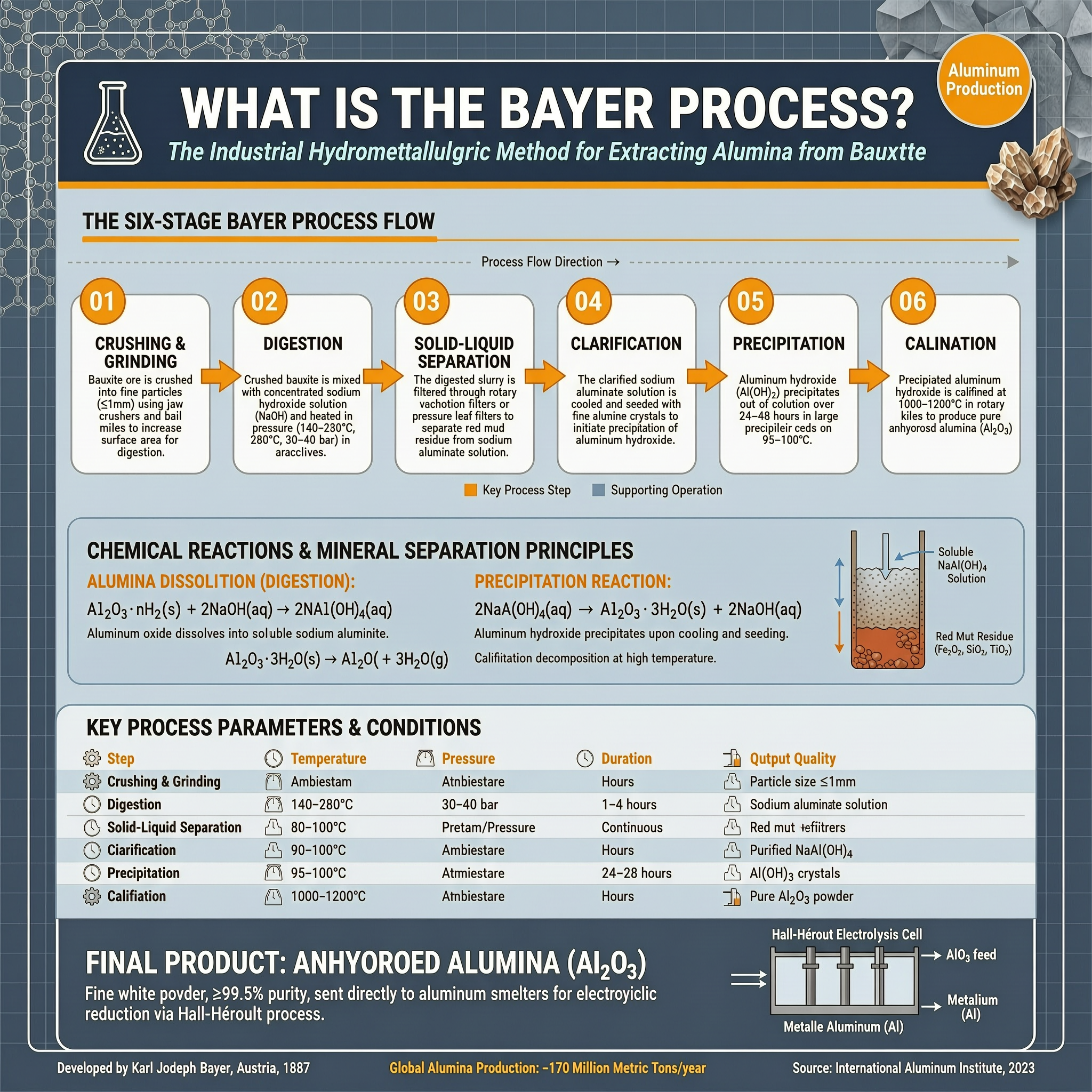
bayer process
How Does the Bayer Process Work?
The Bayer process consists of several major stages. Each stage performs a different function in converting bauxite into high-purity alumina.
1. Bauxite Preparation
Bauxite is first mined and transported to the alumina refinery.
Depending on the ore and refinery design, the bauxite may contain:
- Aluminum-bearing minerals
- Iron oxides
- Silica
- Titanium minerals
- Water
- Organic matter
- Other mineral impurities
The ore is crushed and ground to increase its surface area and prepare it for chemical digestion.
The quality and mineralogy of the bauxite have a significant influence on the subsequent process because different ores require different operating conditions.
2. Digestion With Caustic Soda
The prepared bauxite is mixed with a concentrated sodium hydroxide (NaOH) solution and heated under controlled conditions.
The purpose of digestion is to dissolve the aluminum-bearing minerals while leaving many of the unwanted minerals undissolved.
The dissolved aluminum enters the liquor mainly as sodium aluminate.
A simplified representation is:
Aluminum-bearing minerals + NaOH → Sodium aluminate-containing liquor
The actual chemistry is more complex because bauxite contains different aluminum minerals, primarily gibbsite, boehmite, and diaspore, depending on the deposit.
Digestion conditions such as temperature, caustic concentration, residence time, and bauxite mineralogy affect aluminum extraction.
3. Separation of Insoluble Residue
After digestion, the slurry contains dissolved aluminum compounds together with insoluble solid particles.
The insoluble material is separated from the pregnant liquor.
This residue is commonly known as red mud or bauxite residue because of its high iron-oxide content.
The separated liquor contains the dissolved aluminum and is sent to the next stages of the process.
4. Clarification
The pregnant liquor must be clarified before aluminum hydroxide precipitation.
Fine suspended particles are removed through processes such as settling, clarification, and filtration.
Effective clarification is important because residual solids can interfere with precipitation and affect the quality of the alumina product.
The clarified liquor mainly contains dissolved sodium aluminate together with the caustic solution.
How Is Aluminum Hydroxide Precipitated in the Bayer Process?
After clarification, the sodium aluminate liquor is cooled and seeded with fine aluminum hydroxide crystals.
The seed crystals provide surfaces on which new aluminum hydroxide can grow.
Under controlled precipitation conditions, dissolved aluminum is converted back into solid aluminum hydroxide:
Sodium aluminate liquor → Aluminum hydroxide precipitate
The precipitation process is controlled by factors including:
- Temperature
- Seed loading
- Seed surface area
- Residence time
- Liquor composition
- Agitation
- Supersaturation
The precipitated aluminum hydroxide is separated from the spent liquor and washed.
The remaining caustic liquor is generally recycled back into the Bayer process after appropriate treatment and adjustment.
This recycling of the caustic solution is one of the important features of the process.
How Is Alumina Produced From Aluminum Hydroxide?
The aluminum hydroxide produced during precipitation is heated in a calcination process.
At high temperature, aluminum hydroxide loses chemically bound water and is converted into aluminum oxide:
2Al(OH)₃ → Al₂O₃ + 3H₂O
The resulting aluminum oxide is called alumina.
Alumina is a white powder and is the direct feedstock used in the electrolytic production of primary aluminum.
The properties of the alumina, including particle size, morphology, surface area, moisture content, and chemical purity, are important for its performance in the subsequent smelting process.
What Happens to the Red Mud in the Bayer Process?
Red mud is the main solid residue generated during the Bayer process.
It contains the insoluble minerals that remain after the aluminum-bearing components have been dissolved. Its composition varies according to the original bauxite and refinery process, but it commonly contains substantial amounts of iron oxides along with other mineral phases.
Red mud is separated from the process liquor and requires controlled storage or further treatment.
Because it is produced in large quantities, the management and potential utilization of bauxite residue are important environmental and engineering considerations for alumina refineries.
What Factors Affect Bayer Process Efficiency?
The efficiency of the Bayer process depends strongly on the characteristics of the bauxite and the operating conditions of the refinery.
Important factors include:
| Factor | Effect on the process |
|---|---|
| Bauxite mineralogy | Determines digestion behavior and required conditions |
| Alumina content | Influences potential alumina recovery |
| Reactive silica | Can consume caustic soda and form desilication products |
| Digestion temperature | Affects aluminum dissolution |
| Caustic concentration | Influences digestion efficiency |
| Residence time | Determines the extent of digestion |
| Clarification efficiency | Affects liquor cleanliness |
| Seed quality | Influences aluminum hydroxide precipitation |
| Precipitation conditions | Affect yield and crystal properties |
| Calcination conditions | Affect final alumina properties |
The process therefore cannot be reduced to a single fixed temperature, chemical concentration, or reaction time.
Different refineries use different Bayer process configurations according to their bauxite source, production capacity, energy costs, and desired alumina quality.
Why Is Silica Important in the Bayer Process?
Silica is one of the important impurities considered when evaluating bauxite for Bayer processing.
Reactive silica can react with sodium hydroxide and dissolved aluminum species during digestion and form sodium aluminosilicate compounds.
This consumes caustic soda and can also result in aluminum losses.
For this reason, bauxite quality is commonly evaluated not only by its total alumina content but also by factors such as reactive silica and the mineral forms of aluminum present in the ore.
Bauxite mineralogy is therefore an important consideration when designing and operating a Bayer refinery.
Bayer Process vs. Hall-Héroult Process
The Bayer process and Hall-Héroult process are two different stages of primary aluminum production.
| Process | Main raw material | Main product | Purpose |
|---|---|---|---|
| Bayer process | Bauxite | Alumina (Al₂O₃) | Produce alumina from bauxite |
| Hall-Héroult process | Alumina | Molten aluminum | Produce metallic aluminum |
The complete primary aluminum route can be simplified as:
Bauxite → Bayer process → Alumina → Hall-Héroult smelting → Primary aluminum → Casting and further processing
This distinction is important because the Bayer process does not produce metallic aluminum directly.
It produces alumina, which must then undergo electrolytic reduction in an aluminum smelter.
What Happens After the Bayer Process?
The alumina produced by the Bayer process is transported to an aluminum smelter.
In the Hall-Héroult process, alumina is dissolved in a molten fluoride electrolyte and subjected to electrolysis. The aluminum ions are reduced at the cathode to produce liquid metallic aluminum.
The molten aluminum is then transferred from the reduction cells to the cast house.
At this point, the production chain moves from alumina refining and aluminum smelting into molten aluminum processing and casting.
A simplified industrial route is:
Bauxite → Alumina refinery → Alumina → Aluminum smelter → Molten aluminum → Melt treatment → Filtration → Casting
This final section is where aluminum melt-treatment technologies become relevant.
Why Does Molten Aluminum Need Treatment Before Casting?
Once alumina has been converted into metallic aluminum, the molten metal may still require treatment before casting into ingots, billets, slabs, or other semi-finished products.
The main melt-quality concerns are different from those in the Bayer process.
Two important treatment operations are:
Degassing → Reduction of dissolved hydrogen
Filtration → Removal of non-metallic inclusions
Dissolved hydrogen can contribute to porosity during solidification, while non-metallic inclusions can affect the quality of cast products and subsequent processing.
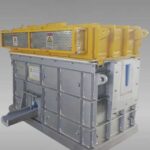
Depending on the casting process and product requirements, aluminum producers may use rotary degassing, ceramic foam filtration, plate-type filtration, cartridge filtration, deep-bed filtration, and related equipment.
What Equipment Is Used for Aluminum Melt Treatment?
The equipment required depends on the aluminum alloy, casting method, metal flow rate, cleanliness requirements, and plant configuration.
| Equipment | Main function |
|---|---|
| On-line degassing unit | Reduce dissolved hydrogen in molten aluminum |
| Ceramic foam filter | Remove non-metallic inclusions |
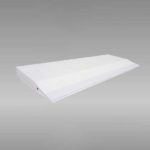
| Plate-type filter equipment | Provide controlled filtration before casting |
| Cartridge filter equipment | Provide additional or fine filtration |
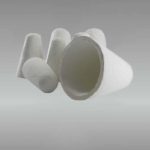
| Cartridge filter tube | Filtration component for suitable systems |
| Molten aluminum launder | Transfer molten aluminum between process units |
For example, a casting line may be arranged as:
Holding furnace → On-line degassing → Filtration → Launder → Casting machine
Not every aluminum plant uses the same configuration. The equipment should be selected according to the actual casting process and required metal cleanliness.
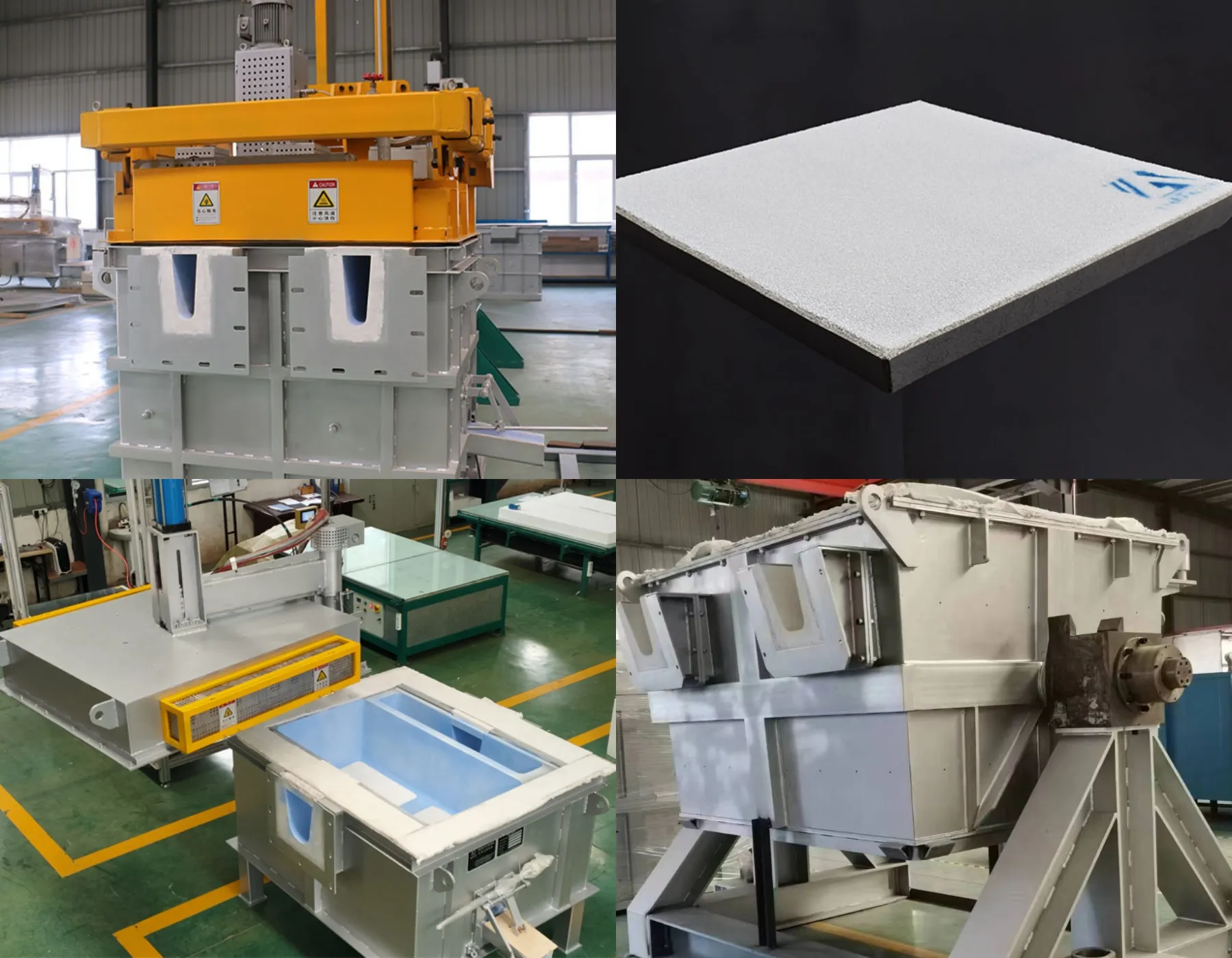
adtech filtration°assing equipment and material
Learn More About Our Molten-Aluminum Treatment
Bayer Process and the Aluminum Production Chain
The Bayer process is only one stage of the complete aluminum production chain.
The relationship can be summarized as:
Bauxite
↓
Bayer process
↓
Alumina
↓
Hall-Héroult electrolytic smelting
↓
Molten aluminum
↓
Melt treatment and filtration
↓
Casting
↓
Rolling / extrusion / other downstream processing
The Bayer process is therefore directly related to aluminum production, but it belongs to the alumina refining stage, rather than molten aluminum purification or casting.
For companies involved in the later stages of aluminum production, melt-treatment equipment becomes relevant after alumina has already been converted into metallic aluminum.