Molten aluminum is never as clean as it looks. Even in a well-managed furnace, the melt carries oxides, spinels, refractory fragments, flux residues, and other non-metallic inclusions that are invisible to the naked eye but devastating to casting quality. These contaminants cause porosity, hard spots, surface blemishes, reduced ductility, poor machinability, and pressure leaks — the kind of problems that turn a profitable casting run into an expensive exercise in scrap and rework.
An alumina ceramic foam filter is the most widely used solution for removing these inclusions from molten aluminum before it enters the mold. It works, it is cost-effective, and when manufactured properly, it delivers remarkably consistent results across a wide range of casting processes. But “when manufactured properly” is doing a lot of heavy lifting in that sentence. The difference between a well-made alumina ceramic foam filter and a poorly made one is not always visible in the box. It becomes painfully visible in the casting.
This page covers what an alumina ceramic foam filter actually does, how it works at the metallurgical level, what to look for in terms of specifications and quality, how to select the right grade for your process, and what real-world performance looks like when filtration is done correctly. Whether you run a gravity die casting shop, a continuous billet line, or a wheel casting operation, the information here is meant to help you make better decisions about filtration — not just buy more filters.
What Is an Alumina Ceramic Foam Filter and How Does It Work?
An alumina ceramic foam filter is an open-cell ceramic structure made primarily from aluminum oxide (Al₂O₃). It is produced by coating a polyurethane foam precursor with a ceramic slurry, then firing the coated foam at high temperature. During firing, the polyurethane burns away completely, leaving behind a rigid, lightweight ceramic skeleton with a network of interconnected pores.
When molten aluminum passes through this pore network, inclusions are removed through two complementary mechanisms:
Mechanical sieving — Particles larger than the pore openings are physically trapped on the filter surface. This is straightforward and effective for coarse inclusions.
Depth filtration — Smaller particles, including those well below the nominal pore size, are captured inside the filter body as they contact the internal ceramic surfaces. Adhesion occurs through a combination of Van der Waals forces, surface tension effects, and the tortuous flow path that forces the metal to change direction repeatedly. Each directional change increases the probability of particle-to-surface contact.
This dual mechanism is what makes ceramic foam filters so much more effective than simple screen-type filters. A fiberglass mesh, for example, can only sieve. It catches what is bigger than the mesh opening and passes everything else. An alumina ceramic foam filter captures inclusions across a much broader size range, often achieving filtration efficiencies above 90% for particles larger than 20 microns.
The choice of alumina as the base material is not arbitrary. Al₂O₃ is chemically inert in contact with molten aluminum at normal casting temperatures (680–750°C), it has excellent thermal shock resistance when properly formulated and fired, and it does not contaminate the melt. These properties make alumina the default material for aluminum filtration worldwide.
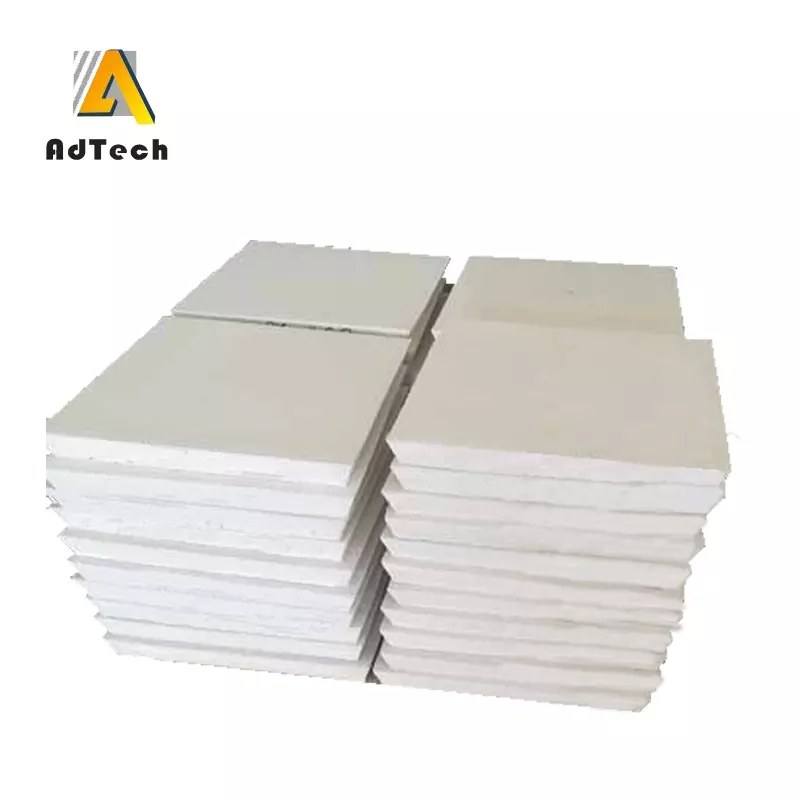
ceramic foam filter
What Are the Key Specifications of an Alumina Ceramic Foam Filter?
Not all alumina ceramic foam filters are equal, even when the datasheets look similar. The specifications that matter most in practice are porosity grade, chemical composition, compressive strength, thermal shock resistance, and dimensional accuracy.
The following table summarises the typical technical specifications for a quality alumina ceramic foam filter used in aluminum casting:
| Property | Specification | Test Method / Reference | Why It Matters |
|---|---|---|---|
| Al₂O₃ Content | 80–85% (typical) | Chemical analysis (XRF) | Determines chemical stability with molten Al |
| Porosity | 80–90% open porosity | Archimedes method | Affects flow rate and filtration capacity |
| Compressive Strength | ≥1.0 MPa (typically 1.0–1.5 MPa) | Uniaxial compression test | Resistance to metallostatic pressure |
| Thermal Shock Resistance | Survives ΔT ≥ 800°C | Quench test (1100°C to room temp) | Prevents cracking on first metal contact |
| Maximum Service Temperature | ~1100°C | Manufacturer specification | Must exceed aluminum pouring temperature |
| Bulk Density | 0.3–0.5 g/cm³ | Weight/volume calculation | Indicates coating uniformity and strut strength |
| Dimensional Tolerance | ±1.5 to ±2.5 mm | Physical measurement | Critical for filter box fit and edge seal |
Data reflects standard industry specifications for alumina-based ceramic foam filters used in aluminum alloy filtration. Values may vary between manufacturers depending on raw material grade and production process.
Which PPI Grade Should You Use for Aluminum Casting?
PPI — pores per inch — is the primary grading system for ceramic foam filters. It indicates the coarseness or fineness of the pore structure and directly affects both filtration efficiency and metal flow rate through the filter.
Choosing the right PPI is not as simple as “finer is better.” The correct grade depends on your alloy, your casting process, your gating system, and the cleanliness level your end product requires. The table below provides a practical guide:
| PPI Grade | Approximate Pore Size | Relative Flow Rate | Filtration Efficiency (≥20μm) | Recommended Applications |
|---|---|---|---|---|
| 10 PPI | 4.0–5.0 mm | Very High | 60–70% | Large billet & slab casting, rough pre-filtration |
| 20 PPI | 2.0–3.0 mm | High | 75–85% | General sand casting, semi-continuous casting |
| 30 PPI | 1.2–1.8 mm | Medium-High | 85–92% | Gravity die casting, wheel casting, most foundry work |
| 40 PPI | 0.8–1.2 mm | Medium | 90–95% | Low-pressure die casting, precision components |
| 50 PPI | 0.6–0.8 mm | Medium-Low | 93–97% | Thin-wall castings, electrical conductor rod |
| 60 PPI | 0.4–0.5 mm | Low | 95–98% | Aerospace, high-purity conductor applications |
Efficiency values are approximate and depend on melt condition, pouring temperature, and gating geometry. Actual results should be verified under production conditions.
Why is 30 PPI the most popular alumina ceramic foam filter grade?
In our experience — and this is consistent across most of the aluminum casting industry — 30 PPI alumina ceramic foam filter is the grade that works for the widest range of applications. It captures the majority of harmful inclusions while maintaining enough flow capacity to fill molds without issues in most standard gating systems.
Foundries casting automotive wheels, engine components, structural parts, and general industrial castings overwhelmingly use 30 PPI as their baseline. It is the practical sweet spot.
When does it make sense to go finer than 30 PPI?
Moving to 40 PPI or 50 PPI makes sense when the casting specification demands higher metal cleanliness — for example, aerospace structural castings, electrical conductor rod where conductivity is affected by inclusions, or thin-wall pressure-tight components.
But there is a catch. Finer filters require higher metallostatic head to prime and maintain flow. If your gating system is not designed for a fine filter, you may end up with incomplete filling, cold shuts, or misruns. The filter grade and the gating system need to be considered together, not independently.
Is coarser filtration ever the right choice?
Yes. For high-throughput operations like large billet casting or situations where the melt has already been treated through online degassing and preliminary filtration, a 10 PPI or 20 PPI filter may be perfectly adequate. The coarser filter removes large inclusions and dross fragments without restricting flow, which is exactly what you need in a high-volume continuous casting system.
How Does an Alumina Ceramic Foam Filter Compare to Other Filtration Methods?
Foundries in the aluminum industry have access to several filtration technologies. Each has a role, but they are not interchangeable. The following comparison covers the most common options:
| Filter Type | Structure | Mechanism | Efficiency (≥20μm) | Flow Capacity | Cost | Best Application |
|---|---|---|---|---|---|---|
| Fiberglass Mesh | Woven flat screen | Surface sieving only | 30–40% | Very High | Very Low | Low-end gravity casting, dross holding |
| Extruded Ceramic (Honeycomb) | Straight parallel channels | Mechanical screening | 50–65% | High | Medium | Billet casting with coarse inclusion load |
| Alumina Ceramic Foam | Open-cell 3D foam | Depth + surface filtration | 85–98% | Medium | Medium-High | Most aluminum casting & filtration |
| Bonded Particle Filter | Sintered ceramic granules | Depth filtration | 80–90% | Medium-Low | Medium | Specialty alloy filtration |
| Deep Bed Filter | Packed alumina media bed | Multi-layer depth filtration | 90–99% | Low | High | Primary smelter CFF units, very high purity |
Comparison based on general industry performance data for aluminum alloy filtration at standard casting temperatures (700–750°C).
The key takeaway is that alumina ceramic foam filters offer the best combination of filtration efficiency, practical usability, and cost for the vast majority of aluminum casting operations. Deep bed filters can achieve higher purity levels, but they are complex systems typically found in primary smelters, not foundries. Fiberglass mesh is cheap but barely qualifies as filtration by modern standards.
What Determines the Quality of an Alumina Ceramic Foam Filter?
This is where many buyers get misled. Two filters can have the same PPI printed on the label and look similar in the carton, yet perform very differently in production. The quality factors that actually matter are mostly invisible to the buyer until the filter is in use.
Slurry formulation and coating uniformity
The ceramic slurry that coats the polyurethane foam precursor is the most critical variable in production. Its composition — the particle size distribution of the alumina powder, the binder chemistry, the rheological properties — determines how uniformly the coating adheres to the foam struts, how thick the ceramic walls become, and how open and interconnected the final pore structure is.
A poorly formulated slurry leads to blocked pores, thin spots, uneven wall thickness, and weak struts. These defects reduce filtration performance and mechanical strength. They also cause batch-to-batch inconsistency, which is perhaps the most frustrating problem for foundries trying to run a stable process.
Firing temperature and kiln control
The firing step sinters the alumina particles into a strong, stable ceramic structure and burns away the polyurethane precursor completely. If firing temperature is too low, the ceramic remains weak and porous in a bad way — not the controlled open porosity you want, but structural weakness in the strut walls themselves. If firing is uneven across the kiln, some filters in the batch will be properly sintered while others are not.
Tunnel kilns with precise temperature profiling produce the most consistent results. Batch kilns or poorly controlled continuous kilns introduce variability that shows up as inconsistent compressive strength and thermal shock resistance.
Dimensional accuracy
A filter that does not fit properly in the filter print or CFF box will allow metal bypass around the edges. This is one of the most common causes of “filtration failure” — the filter itself may be fine, but if metal flows around it rather than through it, inclusions pass straight into the casting.
Good dimensional control — typically ±1.5 mm on smaller sizes and ±2.5 mm on larger sizes — requires consistent foam precursor quality, controlled slurry application, and careful post-firing inspection.
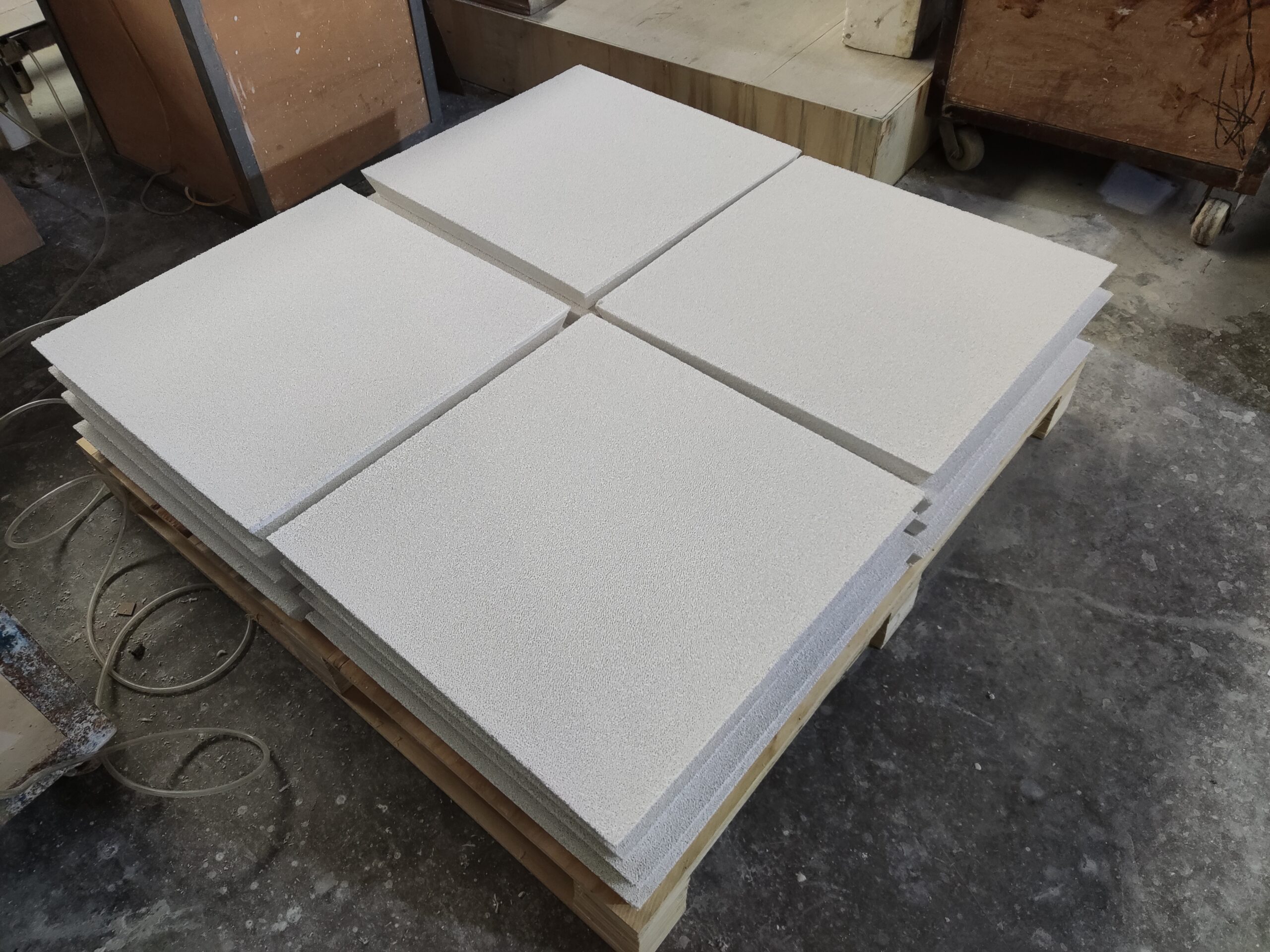
ceramic foam filter for aluminum
How Should You Install an Alumina Ceramic Foam Filter for Best Results?
Even the best filter will underperform if the installation is wrong. These are the practical points that matter most:
Proper seating in the filter print
The filter must sit flush in a well-designed print with minimal gap around the edges. Any gap becomes a bypass channel for unfiltered metal. The print should be dimensioned to match the filter size closely, with a slight interference fit or gasket seal.
Adequate metallostatic head for priming
The filter needs to be fully primed — all pores filled with metal — before the mold cavity begins to fill. Insufficient head pressure leads to partial priming, which means some pores remain empty, effective filter area is reduced, and the risk of cold metal reaching the cavity increases.
For a 30 PPI alumina ceramic foam filter, a minimum metal head of 100–150 mm above the filter is typically recommended. Finer grades require more head.
Horizontal orientation in most cases
For gravity and low-pressure casting, horizontal placement (filter lying flat) is generally more effective than vertical. Horizontal orientation allows metal to flow downward through the full filter face under gravity, maximising filtration contact and priming uniformity.
Integration with the overall melt treatment system
Filtration works best as part of a complete melt treatment approach. Combining an alumina ceramic foam filter with upstream degassing, proper fluxing, and controlled metal transfer gives consistently better results than relying on the filter alone. Many operations also use ceramic fiber products for launder lining and insulation to maintain metal temperature and minimise oxide generation during transfer.
Real Case: How a Southeast Asian Wheel Casting Plant Cut Scrap by 40%
This is not a hypothetical example. It happened in 2025 at a motorcycle wheel casting facility in Thailand that was running twelve gravity die casting machines.
The problem
The plant was sourcing alumina ceramic foam filters from a regional supplier at a competitive price. Monthly consumption was around 8,000 filters, all 12″ × 12″ at 30 PPI. Scrap due to inclusion-related defects — pinhole porosity, oxide trails visible after machining, and occasional hard spots causing tool breakage — was running at approximately 6.8% of total production. The plant’s quality team had traced a significant portion of these defects back to inconsistent filter performance.
Specific issues included:
- PPI variation within the same shipment (measured values ranging from 24 to 34 PPI on filters labeled as 30 PPI)
- Dimensional inconsistency causing metal bypass in the filter print
- Occasional filter cracking during pouring, introducing ceramic fragments into castings
- No technical support from the existing supplier beyond basic order processing
What changed
The plant’s engineering team reached out to evaluate alternatives. After initial testing with sample filters, they placed a trial order of 2,000 pieces of 30 PPI alumina ceramic foam filters along with matching filter print dimensions.
During the trial period, the technical team worked directly with the plant to review gating design on three high-rejection part numbers, adjust filter positioning in two mold sets where bypass had been an issue, and establish incoming inspection criteria for PPI verification and dimensional checks.
The results
Over the first three months of full-scale use:
- Inclusion-related scrap dropped from 6.8% to 4.1% — a reduction of approximately 40%
- Filter cracking during pouring was eliminated entirely
- Machining tool life on post-cast operations improved by an estimated 15% due to cleaner metal
- The plant standardised on a single filter source, simplifying procurement and quality control
The plant has continued to reorder on a quarterly basis since then. They later added hot top casting components for a separate billet casting line at the same facility, consolidating their consumable supply chain.
This is not an unusual outcome. It is what happens when consistent filter quality meets proper application support. The filter itself is important, but how it fits into the total process matters just as much.
What Sizes Are Available for Alumina Ceramic Foam Filters?
Standard alumina ceramic foam filter sizes follow established industry dimensions designed to fit common filter boxes and gating prints used in foundries and casting plants worldwide.
| Nominal Size (inches) | Metric Dimensions (mm) | Thickness (mm) | Tolerance (mm) | Common Application |
|---|---|---|---|---|
| 7″ × 7″ | 178 × 178 | 50 | ±1.5 | Small gravity die casting, lab & sample casting |
| 9″ × 9″ | 228 × 228 | 50 | ±1.5 | Medium gravity & sand casting |
| 12″ × 12″ | 305 × 305 | 50 | ±2.0 | Wheel casting, general foundry use |
| 15″ × 15″ | 381 × 381 | 50 | ±2.0 | Billet casting, continuous casting lines |
| 17″ × 17″ | 432 × 432 | 50 | ±2.0 | Slab casting, large-volume filtration |
| 20″ × 20″ | 508 × 508 | 50 | ±2.5 | Primary smelter filtration systems |
| 23″ × 23″ | 584 × 584 | 50 | ±2.5 | High-throughput smelter CFF box systems |
Dimensions shown are standard catalogue sizes. Custom dimensions and thicknesses are available on request for non-standard filter box configurations.
Custom sizing matters more than many buyers realise. If your casting plant was originally set up with a different filter supplier’s specifications, and the standard sizes from a new supplier do not match exactly, you face a choice: modify your filter box hardware (expensive and time-consuming) or find a manufacturer that can make filters to your existing dimensions. The ability to supply custom sizes without minimum order penalties is a meaningful advantage in practice.
Contact us for products tailored to your factory’s needs
Why Does Alumina Ceramic Foam Filter Quality Vary So Much Across Suppliers?
This is a fair question, and the answer is mostly about manufacturing discipline rather than secret technology.
The basic process for making an alumina ceramic foam filter — coat foam with slurry, fire it, inspect it — is well understood. There are no real secrets. What varies enormously is how carefully each step is controlled.
Foam precursor quality — The polyurethane foam used as the precursor determines the basic pore structure. Cheap foam with irregular cell size produces filters with uneven porosity. Better foam costs more but delivers consistent PPI.
Slurry preparation — Particle size distribution, solid loading, binder ratio, and mixing time all affect coating quality. Laboratories that test and adjust slurry batch by batch produce more consistent filters than those that mix by recipe and hope for the best.
Coating application — Whether the foam is dip-coated, vacuum-coated, or pressure-coated affects how uniformly the slurry penetrates the foam structure. Excess slurry must be removed evenly — if some pores remain blocked, effective porosity and flow are reduced.
Kiln firing — Temperature ramp rate, peak temperature, hold time, and cooling rate must be controlled precisely. Under-fired filters are weak. Over-fired filters can become brittle. Unevenly fired batches produce inconsistent results.
Quality inspection — The final check. Good manufacturers inspect PPI, dimensions, weight, and appearance on every batch. Some also perform compressive strength and thermal shock testing on statistical samples. Manufacturers that skip or reduce inspection are the ones whose filters cause problems in production.
The point is that any manufacturer can produce a good filter on a good day. The question is whether they produce good filters consistently, batch after batch, shipment after shipment. That consistency is what buyers should be evaluating when they compare alumina ceramic foam filter suppliers.
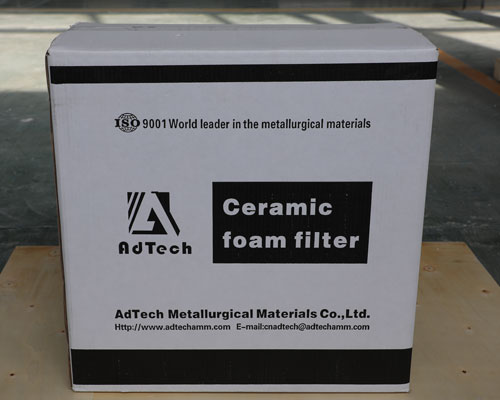
AdTech Alumina Ceramic Foam Filter
What Role Does Filtration Play in the Broader Aluminum Melt Treatment Process?
Filtration is one part of a larger system. In a well-run aluminum casting operation, melt treatment typically includes:
- Furnace fluxing — Chemical treatment to reduce oxide and alkali metal content in the melt
- Degassing — Rotary degassing or lance degassing to reduce dissolved hydrogen below target levels (typically < 0.15 ml/100g for quality castings)
- Settling — Allowing time for heavier inclusions to sink or lighter ones to float before transfer
- Filtration — Removing remaining inclusions as the metal passes through the ceramic foam filter during pouring or transfer
- Controlled transfer — Minimising turbulence, re-oxidation, and temperature loss during metal movement
Each step addresses a different aspect of melt cleanliness. Skipping any one of them puts more burden on the others. In practice, the foundries that achieve the best casting quality are the ones that treat melt cleanliness as a system rather than expecting any single tool — including the filter — to compensate for problems elsewhere.
This is why many casting operations that use alumina ceramic foam filters also invest in degassing equipment and other melt treatment technologies. The combination delivers results that no single component can achieve alone.
How Is the Market for Alumina Ceramic Foam Filters Evolving?
Several trends are shaping demand and quality expectations in this market:
Lightweighting in automotive — The ongoing shift from ferrous to aluminum components in vehicles is expanding casting volumes globally, particularly in Asia. More castings mean more filters, but also higher quality expectations as automotive OEMs tighten inclusion specifications.
Aerospace growth — Commercial aircraft production recovery post-pandemic is driving demand for high-purity aluminum castings where 50 PPI and 60 PPI filters are standard requirements.
Electrical conductor applications — Aluminum rod for electrical conductors requires very low inclusion content to maintain conductivity. This segment increasingly specifies fine-grade alumina ceramic foam filters.
Sustainability pressure — Recycled aluminum content is increasing across the industry, which generally means dirtier melts with higher inclusion loads. This makes effective filtration more important, not less.
Quality consolidation — Buyers are moving away from fragmented, price-driven purchasing toward fewer, more reliable filter suppliers who can provide consistent quality and technical support. The era of buying the cheapest available filter and hoping for the best is ending for any foundry that takes quality seriously.
What Should You Ask Before Ordering Alumina Ceramic Foam Filters?
If you are evaluating a new alumina ceramic foam filter supplier or reconsidering your current source, these are the questions worth asking:
- What is the actual measured PPI on recent production batches, not just the nominal rating?
- What is the Al₂O₃ content of the filter body?
- What compressive strength does the filter achieve?
- How is dimensional tolerance controlled and verified?
- Can the supplier provide filters in custom sizes without excessive minimum orders?
- Does the supplier offer technical guidance on PPI selection, gating design, and filter positioning?
- What is the supplier’s track record for delivery consistency and lead time reliability?
- Can the supplier support related melt treatment needs beyond just filtration?
These questions separate real manufacturers from resellers. They also help you avoid the cycle of switching suppliers every six months because the latest “low-cost” option turned out to be low-quality as well.
For foundries and casting plants that want to evaluate what consistent alumina ceramic foam filter performance actually looks like in production, the most practical next step is a controlled trial with proper measurement. That means testing the filter under your actual production conditions — your alloy, your temperature, your gating, your rejection criteria — and measuring the result objectively.
That is the kind of evaluation we support through our complete aluminum casting product range , and it is the approach that leads to genuine, long-term supplier relationships rather than endless price shopping.
FAQ
1. What is an alumina ceramic foam filter used for?
It removes non-metallic inclusions like oxides, slag, and refractory particles from molten aluminum during casting.
2. What PPI grade is best for general aluminum casting?
30 PPI is the most widely used grade, offering a practical balance between inclusion removal and metal flow.
3. How does an alumina ceramic foam filter work?
It combines surface sieving with depth filtration — inclusions are trapped both on the surface and inside the tortuous pore network.
4. Can alumina ceramic foam filters be used for alloys other than aluminum?
Alumina filters are designed for aluminum. For iron or steel casting, zirconia or silicon carbide filters are more suitable.
5. What causes a ceramic foam filter to crack during pouring?
Poor thermal shock resistance, usually caused by under-firing during manufacturing or excessive moisture in the filter.
6. How do I prevent metal bypass around the filter?
Use a properly sized filter print with minimal edge gap to ensure metal flows through the filter, not around it.
7. Are finer PPI filters always better?
No. Finer filters need more head pressure. If your gating system cannot support it, filling problems will outweigh filtration benefits.
8. What is the standard thickness for alumina ceramic foam filters?
Most standard filters are 50 mm thick, though custom thicknesses are available for specific applications.
9. How should an alumina ceramic foam filter be positioned in the mold?
Horizontal placement is recommended for most gravity and low-pressure casting processes to ensure even priming and flow.
10. Can alumina ceramic foam filters be custom sized?
Yes. Reputable manufacturers can supply non-standard dimensions to fit existing filter boxes without hardware modification.