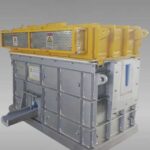
Degassing of Molten Aluminum
Hydrogen is responsible for a large proportion of quality problems encountered in aluminum casting, yet many defects commonly attributed to “high hydrogen content” are actually the result of a broader melt-cleanliness issue. In modern casthouses, successful degassing is not simply about removing dissolved hydrogen. It is about controlling hydrogen pickup, minimizing reabsorption, reducing inclusion-related pore formation, and maintaining stable melt quality from the furnace to the mold.
For extrusion billets, rolling slabs, aluminum alloy conductor rod, and high-performance foundry alloys, effective degassing molten aluminum requires a combination of process control, online degassing technology, filtration systems, and proper melt handling practices. Facilities that focus only on hydrogen removal often continue to struggle with porosity, while those that treat degassing as part of an integrated melt-treatment strategy achieve significantly better casting quality and lower scrap rates.
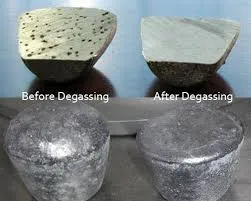
hydrogen in aluminum casting
Why Does Molten Aluminum Absorb Hydrogen So Easily?
Among all common gases present in a casting environment, hydrogen is unique because it exhibits significant solubility in liquid aluminum. Unlike oxygen or nitrogen, which remain largely insoluble, hydrogen can dissolve into molten aluminum and remain undetected until solidification begins.
The primary source of hydrogen is not hydrogen gas itself but moisture.
Water vapor from combustion products, humid air, wet scrap, improperly stored fluxes, inadequately preheated launders, and refractory surfaces can all introduce hydrogen into the melt. At casting temperatures, water molecules dissociate at the metal surface, releasing atomic hydrogen that rapidly diffuses throughout the liquid aluminum.
This process becomes particularly important in recycling operations and aluminum alloy production, where charge materials often contain residual moisture, oils, coatings, or contaminants.
Major Sources of Hydrogen Pickup in Aluminum Casthouses
| Source | Mechanism | Relative Risk |
|---|---|---|
| Wet scrap | Moisture decomposition during melting | Very High |
| Humid furnace atmosphere | Continuous hydrogen absorption at melt surface | High |
| Poorly preheated launders | Condensation and moisture release | High |
| Wet skimming tools | Localized hydrogen contamination | High |
| Improperly stored fluxes | Moisture transfer into melt | Medium |
| Combustion by-products | Water vapor generation during heating | Medium |
One important observation is that hydrogen pickup does not stop once furnace treatment is completed. Hydrogen can be reintroduced at multiple points between the holding furnace and the casting station if transfer systems are not properly managed.
This explains why some facilities report acceptable hydrogen measurements at the furnace while still experiencing porosity in final cast products.
Why Is Degassing Critical for Aluminum Alloy Rod and Conductor Production?
The importance of degassing becomes even greater in aluminum alloy conductor manufacturing.
Compared with conventional steel-reinforced aluminum conductors, modern aluminum alloy conductors provide lower weight, improved corrosion resistance, greater flexibility, and superior sag performance. As a result, their use in transmission and distribution networks has expanded significantly worldwide.
However, these benefits depend heavily on melt quality.
Many conductor alloys contain magnesium as a strengthening element. While magnesium improves mechanical properties, it also affects hydrogen behavior within the melt. Magnesium-containing alloys generally exhibit a greater tendency to absorb hydrogen than commercially pure aluminum grades.
If dissolved hydrogen and non-metallic inclusions are not adequately removed, several quality issues may occur:
- Reduced bending performance
- Lower torsional strength
- Internal porosity
- Surface cracking during wire drawing
- Inconsistent electrical conductivity
- Premature failure during service
Because conductor rod undergoes multiple downstream deformation processes, even small defects present during casting can become amplified during rolling and drawing operations.
For this reason, hydrogen control is considered a key quality parameter throughout conductor production.
How Does Hydrogen Cause Porosity During Solidification?
Hydrogen-related defects originate from a fundamental metallurgical characteristic of aluminum: hydrogen solubility changes dramatically during solidification.
Liquid aluminum can dissolve substantially more hydrogen than solid aluminum. As solidification progresses, excess hydrogen can no longer remain in solution and must either escape from the melt or form gas pores within the casting structure.
Relative Hydrogen Solubility in Aluminum
| Condition | Relative Hydrogen Solubility |
|---|---|
| Fully Liquid | High |
| Semi-Solid | Rapidly Decreasing |
| Fully Solid | Extremely Low |
This sharp reduction in solubility creates favorable conditions for pore formation.
If hydrogen levels remain excessive during casting, gas bubbles become trapped between growing dendrites and eventually solidify within the metal structure.
The result may include:
- Gas porosity
- Pinholes
- Surface blistering after heat treatment
- Reduced fatigue resistance
- Reduced tensile properties
- Lower pressure-tightness
In severe cases, porosity can remain hidden until machining, extrusion, rolling, or final inspection reveals the defect.
Contact Us for technical consultation
Why Does Porosity Sometimes Remain After Degassing?
This is one of the most common questions in aluminum casting.
Many producers assume that once hydrogen content is reduced, porosity problems should disappear. In practice, porosity formation is influenced by both dissolved hydrogen and melt cleanliness.
Several factors can contribute to residual porosity even after successful degassing.
Hydrogen Reabsorption After Treatment
Hydrogen removal achieved inside a degassing chamber can be partially lost if the molten aluminum is subsequently exposed to moisture or excessive turbulence.
Open launders, wet refractory surfaces, and poor transfer practices are common causes of reabsorption.
Oxide Films Acting as Nucleation Sites
Hydrogen alone does not always create large pores.
Oxide films suspended in the melt often serve as nucleation sites where hydrogen accumulates and expands during solidification.
This means that two melts with identical hydrogen levels may exhibit completely different porosity characteristics depending on their inclusion content.
Turbulent Metal Flow
Excessive turbulence increases oxidation and generates additional bifilm defects.
These defects provide ideal locations for pore formation and often reduce the effectiveness of downstream quality control measures.
For this reason, modern aluminum producers increasingly focus on melt cleanliness rather than hydrogen content alone.
How Does an Online Aluminum Degassing System Remove Hydrogen?
Online degassing systems operate according to the principle of hydrogen partial pressure equilibrium.
Hydrogen dissolved in molten aluminum exists in equilibrium with the surrounding gas phase. When an inert gas bubble with a lower hydrogen partial pressure is introduced into the melt, hydrogen naturally diffuses from the aluminum into the bubble.
The greater the difference in hydrogen partial pressure, the stronger the driving force for diffusion.
As the bubble rises through the molten aluminum, hydrogen continuously transfers into the gas phase and is eventually removed from the system.
This mechanism explains why inert gas quality is extremely important.
Factors That Determine Degassing Efficiency
| Parameter | Effect on Performance |
|---|---|
| Gas purity | Higher purity improves hydrogen removal |
| Bubble size | Smaller bubbles increase surface area |
| Bubble distribution | Uniform dispersion improves mass transfer |
| Residence time | Longer contact improves diffusion |
| Rotor design | Controls bubble generation quality |
| Melt turbulence | Excessive turbulence reduces efficiency |
The objective is not simply to inject more gas.
Effective degassing depends on generating a large number of finely dispersed bubbles that remain in contact with the melt for the longest practical time.
This is why modern online degassing systems typically employ graphite rotors operating within carefully controlled speed ranges rather than relying on simple gas injection.
In many industrial applications, rotor speeds between 400 and 500 rpm provide an effective balance between bubble refinement and process stability.
Why Are Small Bubbles More Effective for Hydrogen Removal?
Hydrogen transfer occurs at the interface between the gas bubble and the molten aluminum.
A single large bubble may contain the same gas volume as thousands of smaller bubbles, but its available surface area is significantly lower.
As bubble size decreases:
- Total surface area increases
- Mass transfer efficiency improves
- Hydrogen diffusion accelerates
- Degassing performance becomes more stable
Equally important is bubble residence time.
Bubbles that rise too quickly through the melt have insufficient time to absorb hydrogen. The most effective systems therefore focus on creating finely dispersed bubbles with uniform distribution throughout the treatment chamber.
In practical terms, successful degassing follows three fundamental principles:
- Use high-purity inert gas.
- Generate the maximum number of fine bubbles.
- Maximize bubble residence time within the melt.
These principles remain the foundation of modern aluminum degassing technology.
Argon vs Nitrogen: Which Degassing Gas Is Better for Molten Aluminum?
One of the most frequently debated topics in aluminum melt treatment is whether argon or nitrogen provides better degassing performance.
The reality is that neither gas is universally superior. The most suitable choice depends on alloy type, cleanliness requirements, operating costs, and production objectives.
Both gases are classified as inert under normal aluminum processing conditions and are widely used in rotary degassing systems. Their primary role is not to react with hydrogen but to create a gas-metal interface that allows dissolved hydrogen to diffuse out of the melt.
Comparison of Argon and Nitrogen in Aluminum Degassing
| Parameter | Argon | Nitrogen |
|---|---|---|
| Relative Cost | High | Low |
| Hydrogen Removal Efficiency | Excellent | Very Good |
| Availability | Moderate | Excellent |
| Operating Cost | Higher | Lower |
| Typical Application | Aerospace, High-Purity Alloys | Billet, Rod, Slab, General Casting |
| Gas Density | Higher | Lower |
Argon generally produces slightly better hydrogen removal performance because it is completely inert and does not participate in any secondary reactions within the melt.
However, the performance difference is often smaller than many operators assume.
In industrial billet casting, rolling slab production, and conductor rod manufacturing, nitrogen-based rotary degassing systems frequently achieve hydrogen levels comparable to those obtained with argon when process parameters are properly optimized.
For this reason, nitrogen remains the most widely used degassing gas in commercial aluminum production.
When Is Argon Worth the Additional Cost?
Argon is typically selected when:
- Extremely low hydrogen levels are required
- Aerospace-grade alloys are produced
- Premium casting quality is necessary
- Scrap rates are particularly expensive
- Process stability is prioritized over operating cost
For most commercial applications, however, rotor performance, bubble distribution, filtration efficiency, and melt handling practices have a greater impact on final product quality than the choice between argon and nitrogen.
A poorly operated argon degassing system will often perform worse than a well-optimized nitrogen-based system.
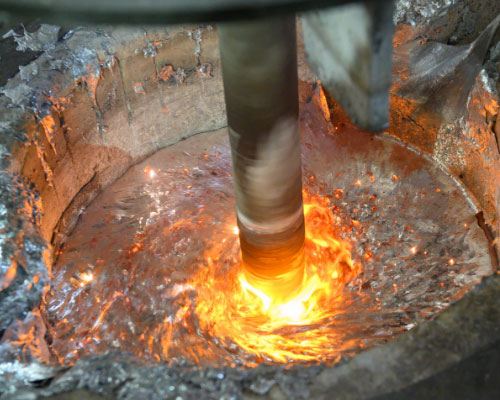
Degassing of Molten Aluminum
What Are the Most Common Mistakes That Reduce Degassing Efficiency?
Many casting defects attributed to equipment limitations are actually caused by process-control issues.
Even advanced online degassing systems cannot consistently deliver high melt quality if upstream and downstream practices are not properly managed.
Using Wet or Contaminated Charge Materials
Hydrogen removal becomes significantly more difficult when excessive moisture enters the melting process.
Wet scrap, oily returns, and improperly stored alloying materials can introduce large amounts of hydrogen before degassing even begins.
The most effective hydrogen-removal strategy is always prevention first and treatment second.
Reducing hydrogen pickup at the source lowers gas consumption, shortens treatment times, and improves process consistency.
Operating Outside the Optimum Rotor Speed Range
Some operators assume that higher rotor speeds automatically improve degassing efficiency.
In reality, excessive rotor speed may increase turbulence, generate additional oxide films, accelerate rotor wear, and reduce overall melt cleanliness.
Conversely, speeds that are too low may produce coarse bubbles with insufficient surface area.
The objective is not maximum rotation but optimum bubble generation.
For most online degassing systems, rotor speeds between 400 and 500 rpm provide an effective balance between bubble refinement and process stability.
Excessive Inert Gas Flow
Increasing gas flow does not always increase hydrogen removal.
Beyond a certain point, additional gas tends to form larger bubbles that rise rapidly through the melt.
These bubbles provide less contact time and lower mass-transfer efficiency.
Many facilities achieve better results by optimizing bubble quality rather than simply increasing gas consumption.
Neglecting Launder and Transfer System Design
Hydrogen removal achieved inside the degassing chamber can be partially lost during metal transfer.
Poorly insulated launders, excessive free-fall zones, abrupt flow transitions, and exposed metal surfaces may all contribute to reoxidation and hydrogen reabsorption.
This is one reason why modern casthouses increasingly evaluate the entire melt-treatment system rather than focusing exclusively on the degassing unit.
Ignoring Inclusion Control
Hydrogen content is only part of the quality equation.
Oxide films, spinels, refractory fragments, and bifilms often play an equally important role in casting defects.
Without effective filtration, acceptable hydrogen measurements may still be accompanied by unacceptable product quality.
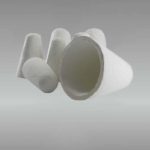
This explains why online degassing systems are frequently installed together with ceramic foam filtration systems and dedicated filter boxes.
The objective is not simply to produce low-hydrogen aluminum, but to produce clean aluminum.
Assuming a Single Measurement Represents the Entire Process
Hydrogen content is dynamic.
Measurements taken at the holding furnace may not accurately represent conditions at the casting station.
Changes in temperature, transfer practices, launder design, and holding time can all influence final melt quality.
Successful producers focus on maintaining process stability throughout the entire casting operation rather than relying solely on isolated measurements.
Why Are Integrated Melt Treatment Systems Becoming the Industry Standard?
Over the past decade, aluminum producers have shifted away from treating degassing, filtration, and metal transfer as independent operations.
Modern casthouses increasingly recognize that melt quality is determined by the combined performance of the entire system.
A high-efficiency degassing unit cannot compensate for poor launder design.
A premium ceramic foam filter cannot eliminate defects generated by excessive turbulence upstream.
Likewise, excellent furnace practices cannot prevent contamination introduced during transfer.
For this reason, leading aluminum producers are investing in integrated melt treatment solutions that combine online degassing systems, filtration equipment, filter boxes, heated launders, and flow-control technology.
By treating hydrogen removal, inclusion control, and transfer management as interconnected processes, manufacturers achieve more consistent melt cleanliness, lower defect rates, and improved casting performance across a wide range of aluminum products.
FAQ
1. What is the most effective method for degassing molten aluminum?
Rotary degassing is widely regarded as the most effective industrial method for removing dissolved hydrogen from molten aluminum. By injecting inert gas through a rotating graphite rotor, the process creates fine bubbles that promote hydrogen diffusion and removal. For high-quality billet, slab, and conductor rod production, rotary degassing is often combined with ceramic foam filtration to improve overall melt cleanliness.
2. Why does porosity still appear after aluminum degassing?
Porosity can remain even after successful degassing because hydrogen is not the only cause of casting defects. Oxide films, bifilms, refractory particles, and other inclusions can act as nucleation sites for gas pores during solidification. Inadequate filtration, hydrogen reabsorption, and excessive turbulence during metal transfer may also contribute to residual porosity.
3. What hydrogen level is considered acceptable in molten aluminum?
The acceptable hydrogen content depends on the alloy and final product requirements. Typical targets range from 0.08–0.20 ml/100 g Al. High-performance applications such as aerospace castings and premium extrusion billets generally require lower hydrogen levels than standard commercial alloys.
4. Is argon better than nitrogen for aluminum degassing?
Argon typically provides slightly higher degassing efficiency because it is completely inert. However, nitrogen is significantly less expensive and can achieve comparable results in many billet, slab, and conductor rod applications when operating parameters are properly optimized. In practice, equipment design and process control often have a greater impact on performance than gas selection.
5. Does degassing remove inclusions from molten aluminum?
Not completely. Rotary degassing can help float some inclusions to the melt surface, but its primary function is hydrogen removal. Non-metallic inclusions such as oxide films, spinels, carbides, and refractory particles are more effectively removed through ceramic foam filtration and other filtration technologies.
6. Why are ceramic foam filters used after online degassing?
Online degassing and ceramic foam filtration serve different purposes. Degassing removes dissolved hydrogen, while ceramic foam filters capture suspended inclusions. Installing a ceramic foam filter downstream of the degassing system helps improve melt cleanliness and reduces the risk of casting defects caused by non-metallic particles.
7. How long should molten aluminum be degassed?
The required treatment time depends on melt volume, alloy type, hydrogen content, rotor design, and gas flow rate. Typical industrial degassing times range from 5 to 20 minutes. Excessive treatment time does not always improve results and may increase oxidation or operating costs.
8.What causes hydrogen pickup in molten aluminum?
Hydrogen is primarily introduced through moisture. Common sources include wet scrap, humid furnace atmospheres, inadequately preheated launders, wet tools, improperly stored fluxes, and combustion products. Preventing hydrogen pickup is often more cost-effective than removing hydrogen after contamination occurs.
9. How can degassing efficiency be improved?
Degassing efficiency can be improved by using high-purity inert gas, generating smaller and more uniformly distributed bubbles, maintaining appropriate rotor speeds, minimizing melt turbulence, and reducing hydrogen pickup before treatment. Proper filtration and melt-transfer practices also contribute to better overall results.
10. What is the difference between online degassing and ladle degassing?
Ladle degassing is typically performed as a batch process and is suitable for smaller operations. Online degassing is integrated directly into the casting line, allowing continuous treatment of molten aluminum during production. Online systems generally provide more stable hydrogen control, improved process consistency, and better suitability for high-volume casting operations.