Blog - Page 44 of 73 - Tap Out Cone,Refining Flux,Ceramic Foam Filter,Aluminum Cast Materials

Blog

06Nov 2020
Flux Method

Aluminum is a very active metal, which easily reacts with water vapor during the smelting process to generate hydrogen and oxide inclusions (Al2O3). These non-metallic inclusions are very harmful to the performance of aluminum products. Therefore, the purification of aluminum melt is one of the main ways to improve the quality of aluminum products. The […]
03Nov 2020
Hot Top Casting for Aluminum

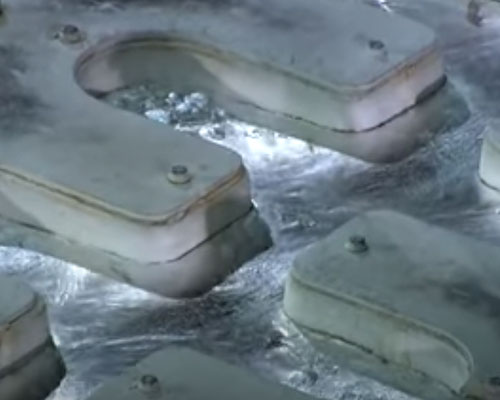
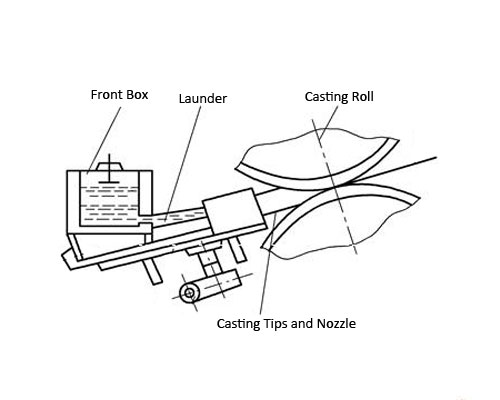
The ingot produced by hot top casting for aluminum has good internal quality, uniform structure, and high mechanical properties, especially the edges of the ingot. This is because the effective crystallization height of the hot top mold is very small, the cooling rate of the ingot is increased, the liquid cavity of the ingot becomes […]

30Oct 2020
Casting System

The main function of the casting system in the strip casting and rolling production line is to transport the liquid aluminum from the holding furnace to the feed nozzle, remove the oxides and gases in the aluminum liquid, and keep the metal pressure in the feed nozzle unchanged, ensuring molten aluminum can be smoothly continuously […]

29Oct 2020
Nozzle Roll Gap

In the continuous casting and rolling process of the slab, the liquid metal uses the static pressure of the liquid level of the front box to continuously deliver the liquid metal to the roll gap through the feed nozzle. When the metal melt gushes from the feed nozzle and the casting roll, the surface touches, […]

29Oct 2020
Cast Non-Ferrous Metals

The production practice of aluminum alloy has proved that hydrogen is a gas that can be dissolved in large amounts in aluminum or aluminum alloy, and the gas with greater solubility in aluminum alloy. All kinds of cast non-ferrous metals have the characteristic of absorbing gas. The solubility of the absorbed gas increases rapidly with the […]

28Oct 2020
Shrinkage Defects

Through exploration and experimentation, in the gravity casting of aluminum alloy wheels, coating thickness, alloy liquid pouring temperature and mold temperature have a great influence on surface shrinkage defects, and the influence of mold temperature is particularly prominent. In the case of too high or too low mold core temperature, shrinkage defects may occur on […]

27Oct 2020
Purification of Molten Aluminum

At present, the comprehensive treatment of the purification and grain refinement of molten aluminum is the basic problem for obtaining high-quality aluminum alloy. According to the different production links, the purification treatment of molten aluminum can be divided into treatment in the furnace and treatment outside the furnace. The aluminum alloy furnace treatment can be […]

27Oct 2020
Gas and Inclusions in Molten Aluminum

The use of aluminum alloy castings is increasing, and the requirements for castings are getting higher and higher. In addition to the requirements to ensure chemical composition, mechanical properties and dimensional accuracy, aluminum alloy castings are not allowed to have shrinkage, porosity, slag holes and other casting defects. The purification of molten aluminum is one […]

24Oct 2020
Removal of Alkali Metals

The removal of alkali metals is also important in aluminum smelting and casting processes. The alkali metals and alkaline earth metals in the aluminum melt mainly come from the alkali metals and alkaline earth metal elements in the aluminum electrolysis process, such as Na, Li, Ca, etc., and also from the aluminum alloy flux. Aluminum […]

24Oct 2020
Aluminum alloy Slag Remover

Aluminum alloy slag remover mainly melts through three methods of adsorption, dissolution and compounding. The dissolution is mainly achieved by adding a chemical substance that can dissolve the inclusions in the slag, and dissolve it according to its similar physical and chemical properties, and then remove it with the flux. For example, Na3AlF6 can dissolve […]