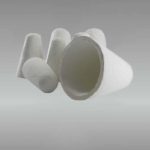
A tap out cone is a vacuum-formed ceramic fiber plug used to seal and control molten aluminium flow at the tap hole of smelting and holding furnaces. Made from high-purity aluminium silicate fiber bonded with inorganic binders, it withstands continuous contact with molten metal above 700 °C while delivering reliable thermal insulation, zero slag adhesion, and consistent plug-to-hole sealing. Below you’ll find material specs, selection guidance, installation practice, and a real production-line case study.
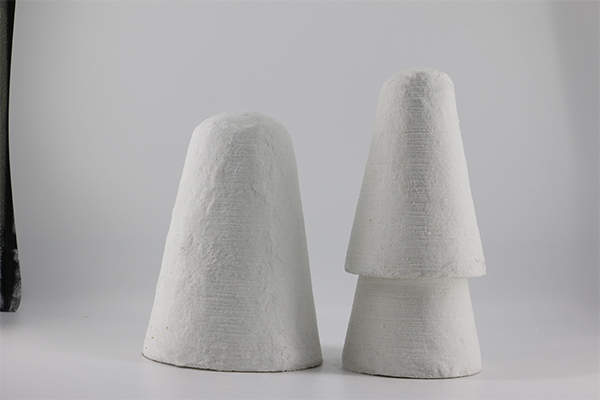
Tap Out Cone for Aluminium Smelter
What Is a Tap Out Cone and How Does It Work?
A tap out cone — sometimes called a tapping cone, tap hole plug, or refractory tap out plug — is a precision-shaped ceramic fiber component inserted into the tap hole (also known as a self-tapping hole or aluminium outlet) of a reverberatory furnace, tilting furnace, or stationary holding furnace. When the operator needs to release molten aluminium into a launder or casting trough, the cone is removed; once flow must stop, a new cone is pressed in to re-seal the opening.
The part is manufactured through a vacuum suction filtration forming process: high-aluminium silicate fibers are blended with an inorganic binder, poured into a mold cavity, and then drawn under vacuum to create a uniform, dense body. This method replaced the older hand-layup technique and delivers three practical advantages:
- Uniform fiber distribution — eliminates soft spots that could blow out under metallostatic pressure.
- Repeatable dimensions — each cone fits the tap hole without trimming, reducing operator exposure time at the furnace face.
- Higher yield — production yield sits around 99 %, which keeps per-unit cost competitive.
After forming, the cone is heat-treated at elevated temperature to cure the binder and burn off volatiles, so the finished part produces very low smoke generation when it contacts molten metal — an important EHS consideration in enclosed pot rooms.
Where Is a Tap Out Cone Used?
| Application | Furnace Type | Typical Alloy |
|---|---|---|
| Primary smelting tap hole | Reverberatory furnace | Pure aluminium (99.7 %) |
| Holding / transfer furnace outlet | Gas-fired holding furnace | Al-Si, Al-Mg casting alloys |
| Zinc smelter tap hole | Induction or reverberatory | Zamak, Zn-Al |
| Magnesium casting furnace | Steel crucible furnace | AZ91, AM60 |
Because the ceramic fiber body is chemically inert to aluminium, magnesium, and zinc melts, the same basic formulation covers all three metal families — only the cone geometry and density change.
What Are the Key Properties of a Ceramic Fiber Tap Out Cone?
Choosing the right tap out cone means matching the plug’s physical and thermal properties to your furnace operating window. The table below summarises the critical parameters for a standard-grade aluminium tap out cone:
| Property | Typical Value | Test Standard / Basis |
|---|---|---|
| Classification temperature | 1 260 °C (2 300 °F) | ISO 10635 |
| Bulk density | 0.4 – 0.8 g/cm³ (adjustable) | ASTM C134 |
| Cold crushing strength | 0.8 – 2.5 MPa | ASTM C133 |
| Thermal conductivity (600 °C) | 0.12 – 0.18 W/m·K | ASTM C201 |
| Linear shrinkage (1 000 °C, 24 h) | ≤ 2 % | ASTM C210 |
| Al₂O₃ content | 45 – 52 % | XRF analysis |
| SiO₂ content | 48 – 54 % | XRF analysis |
| Non-stick aluminium rating | No wetting / no adhesion | In-house melt test |
A few things worth noting from hands-on use:
- Density and hardness are tuneable. By adjusting the binder percentage and vacuum dwell time, the manufacturer can shift density across a 0.4–0.8 g/cm³ window. A denser cone resists erosion longer but is harder to push into the tap hole — so there’s a practical sweet spot for each furnace design.
- Thermal shock resistance matters more than peak temperature rating. The cone goes from ambient to ~720 °C in seconds when it touches the melt. Poor shock resistance causes micro-cracking, which lets aluminium infiltrate the fiber matrix and welds the cone into the hole. That’s a maintenance headache nobody wants.
- Low thermal conductivity keeps the furnace shell cool. With k-values around 0.15 W/m·K, the cone acts as an insulating barrier. This reduces heat loss at the tap hole and protects the surrounding steel casing.
- Low thermal inertia means the cone reaches thermal equilibrium quickly, so there is no extended “cold zone” in the melt stream during the first pour — fewer inclusions end up in the launder.
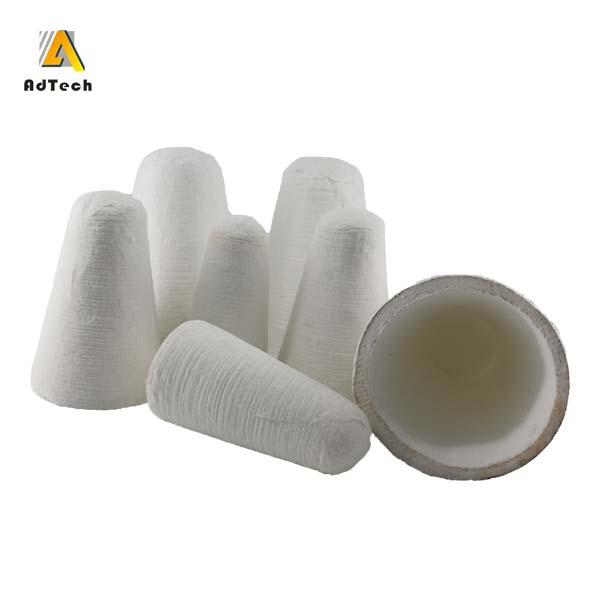
Aluminium Foundry Tap Plugs
How to Select the Right Tap Out Cone Size and Density?
Tap hole geometries vary widely. A 20-tonne reverberatory furnace might use a tapered bore of 50 mm top × 70 mm bottom × 120 mm deep, while a small holding furnace could have a 30 mm × 45 mm × 80 mm bore. The cone must be slightly oversized on its seating diameter to create an interference fit — typically 1–2 mm oversize on the large end.
Step-by-step selection process:
- Measure the tap hole bore at the hot face and cold face (the hole is tapered).
- Specify cone taper angle to match — usually 3°–7° included angle.
- Select density: for high metallostatic head (deep bath furnaces), go 0.6–0.8 g/cm³; for shallow-bath holders, 0.4–0.5 g/cm³ is sufficient.
- Confirm alloy compatibility. Magnesium melts attack silica-rich fibers more aggressively than aluminium; if you’re running Mg alloys, ask for an alumina-enriched formulation.
- Decide on a head or flange detail. Some cones have a mushroom head that sits flush against the furnace shell for easier removal with a simple pry bar.
Custom molds can be manufactured to match any proprietary tap hole profile, so there is no need to modify the furnace refractory to fit a catalogue cone.
Contact Us for technical consultation
Why Does Manufacturing Method Matter for Tap Out Cone Quality?
There are broadly two manufacturing routes in the market:
Hand-formed (traditional): Fiber and binder are hand-packed into a mold and pressed. Fiber orientation is random and density control is poor. Operators report inconsistent sealing — sometimes a cone fits perfectly, the next one leaks.
Vacuum suction filtration (modern): The slurry is drawn through a porous mold under controlled vacuum. Fibers align preferentially along the flow direction, and density is governed by vacuum level and dwell time, both of which are controlled by PLC. The result is a part with:
- Higher and more uniform crushing strength.
- Tighter dimensional tolerance (± 0.5 mm on critical diameters vs. ± 2 mm for hand-formed).
- Non-stick aluminium surface — the smooth, dense skin formed against the mold resists wetting by molten aluminium, so the cone pulls out cleanly for the next cycle.
This is not a trivial difference. In a busy casthouse pouring 200 tonnes per day, a leaking cone shuts down the tap, sends metal onto the floor, and creates a serious safety incident. Consistency is everything.
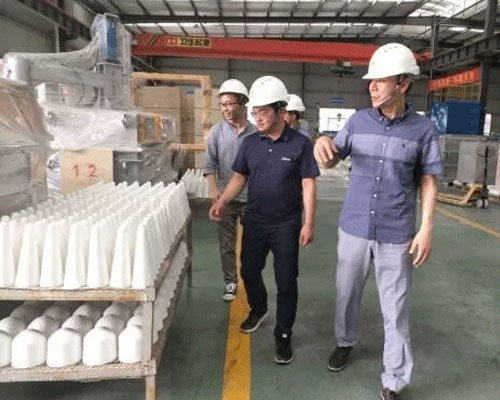
Tap Out Cone for Sale
How Does a Tap Out Cone Compare to Other Tap Hole Sealing Methods?
| Feature | Ceramic Fiber Tap Out Cone | Clay / Graphite Plug | Pneumatic Sliding Gate |
|---|---|---|---|
| Capital cost | Low (consumable) | Low (consumable) | High (mechanical system) |
| Sealing reliability | High — interference fit | Moderate — can crack | Very high — positive shut-off |
| Smoke / fume at insertion | Very low | Moderate (organics in clay) | None |
| Operator skill required | Low | Low | Moderate (maintenance) |
| Suitability for frequent tapping | Good (quick change) | Fair | Excellent |
| Thermal insulation at tap hole | Excellent | Poor (graphite is conductive) | Poor (steel housing) |
| Alloy contamination risk | None (inert fiber) | Possible (carbon pick-up) | None |
For most aluminium casthouses operating reverberatory or holding furnaces with intermittent tapping, the ceramic fiber tap out cone remains the most practical and cost-effective sealing solution. Sliding gate systems make sense only on very large furnaces with continuous or semi-continuous casting lines.
What Should You Watch for During Installation and Removal?
Practical tips drawn from casthouse floor experience:
- Pre-heat the cone if your plant SOP allows it. Placing a new cone on top of the furnace lid for 5–10 minutes before insertion reduces the thermal gradient and lowers the chance of cracking on contact.
- Use a dedicated tapping bar with a cup end that matches the cone head profile. Hammering with a flat bar can split the cone.
- Inspect the tap hole bore between campaigns. Refractory erosion gradually widens the bore, and an undersized cone will leak. If the bore diameter has grown more than 3 mm beyond the original design, re-sleeve the tap hole or step up to the next cone size.
- Never re-use a cone. Once a cone has been wetted by molten metal, its fiber structure is compromised. The cost of a new cone is negligible compared to the cost of a tap hole leak.
- Log cone consumption per campaign. A sudden increase in cone usage usually signals accelerated tap hole erosion — which is a leading indicator that the furnace refractory lining needs attention.
Request A Quote
AdTech Real Case: Holding Furnace Line Upgrade in the Middle East
A secondary aluminium recycler in the United Arab Emirates operates four gas-fired holding furnaces feeding a DC casting line. Each furnace has two tap holes and runs three shifts per day, seven days a week. Before 2022, the plant sourced hand-formed tap out cones from a regional supplier. The main pain points were:
- Inconsistent fit: roughly 1 in 8 cones leaked on first insertion, requiring the operator to pull the cone and try another. Each failed attempt added ~4 minutes of downtime per tap and exposed the crew to splash risk.
- Aluminium adhesion: after contact with the melt, many cones bonded to the tap hole wall. Removal required excessive force, which accelerated refractory wear. The plant was re-sleeving tap holes every 10 weeks.
- Smoke generation: the binder system in the old cones released visible organic fume, triggering repeated observations from the HSE team.
In Q3 2022, the plant trialled 500 vacuum-formed tap out cones supplied by the manufacturer. The cones were custom-dimensioned from measurements of the existing tap holes (52 mm × 72 mm × 115 mm taper, 5° included angle), produced at a density of 0.55 g/cm³.
Results after three months of full deployment (all four furnaces, both tap holes):
| Metric | Before (hand-formed) | After (vacuum-formed) | Improvement |
|---|---|---|---|
| First-insertion seal rate | ~87 % | 99.2 % | +12 percentage points |
| Average cone removal force | High — required 2-man pry bar | Single-hand tap bar | Significantly reduced |
| Tap hole re-sleeve interval | 10 weeks | 18 weeks | +80 % longer refractory life |
| Visible fume at insertion | Moderate | Negligible | HSE observations eliminated |
| Cone consumption per furnace / month | ~140 | ~120 | –14 % (fewer rejects) |
The reduction in re-sleeving frequency alone saved the plant an estimated USD 23 000 per furnace per year in refractory materials and lost production time during maintenance shutdowns. After the trial, the casthouse placed a blanket order for 12 months and integrated the product into its standard operating procedure across all four furnaces. The partnership has continued into its third year, with the supplier’s technical team visiting the site annually to re-measure tap hole profiles and adjust cone dimensions as the furnace refractory wears.
This kind of iterative, data-driven approach to consumable specification is what separates a vendor from a genuine technical partner.
How Does Tap Out Cone Quality Affect Aluminium Casting Safety?
Molten aluminium at 700–750 °C is unforgiving. A blown cone sends a stream of liquid metal onto the casthouse floor, and if it contacts moisture — from a damp floor, a leaking water line, or even sweat — the result is a steam explosion. The Aluminium Association’s safety guidelines and the International Aluminium Institute’s EHS resources both emphasise the criticality of reliable tap hole sealing as a primary engineering control.
A high-quality tap out cone contributes to safety in several direct ways:
- Consistent dimensional accuracy eliminates the guesswork of trying multiple cones at a hot, open tap hole.
- Non-stick surface ensures clean removal without the operator having to apply excessive force close to the melt.
- Low smoke emission keeps visibility high around the tap area — a factor that’s often overlooked until something goes wrong.
If your current cone supplier can’t provide batch-level dimensional inspection data, that’s a red flag worth addressing.
Related Refractory and Filtration Products for Aluminium Casting
A tap out cone is one component in a broader system of ceramic and refractory consumables that keep a casthouse running safely and efficiently. Adjacent products worth evaluating alongside your cone specification include:
- Ceramic foam filters — used downstream in the launder to remove oxide inclusions and non-metallic particles from the melt before it reaches the mold or DC casting table.
- Castertip / casting nozzle — the precision tip that delivers metal into the roll caster or continuous caster, where dimensional stability and thermal shock resistance are equally critical.
- Hot top casting components — insulating rings and transition plates used in vertical DC casting to control solidification and reduce butt curl.
- Degassing equipment — rotary degassing units that reduce dissolved hydrogen before casting, working in concert with good filtration practice to achieve low-porosity billets and slabs.
Sourcing these items from a single supplier who understands how they interact within the casting line — from furnace tap hole through to mold — simplifies logistics and ensures material compatibility.
Specifications You Should Request When Ordering Tap Out Cones
When you send an RFQ, include (or ask the supplier to confirm) the following:
- Tap hole drawing or dimensions — top diameter, bottom diameter, depth, taper angle.
- Density specification — expressed in g/cm³ with acceptable tolerance (e.g., 0.55 ± 0.05).
- Crushing strength minimum — typically ≥ 1.0 MPa for aluminium applications.
- Binder type — inorganic (colloidal silica or alumina-based) is preferred for low smoke; avoid organic binders if your EHS team is sensitive to fume.
- Fibre classification temperature — must exceed your maximum operating temperature by at least 200 °C.
- Surface finish — specify “smooth mold-face skin” on the seating surfaces to ensure non-wetting behavior.
- Packaging — cones are fragile; request individual wrapping and rigid carton packing with dividers.
- Shelf life and storage conditions — ceramic fiber products absorb moisture; confirm maximum storage humidity and shelf life before binder degradation.
If you can provide a sample of a used cone, a good manufacturer will reverse-engineer the geometry and fiber distribution to produce a direct replacement — or propose an improved version based on the wear pattern.
Conclusion
The tap out cone is a small, inexpensive part that sits at the most safety-critical point in the aluminium casting process. Skimping on quality here is a false economy. The difference between a hand-formed plug and a vacuum-formed, dimensionally controlled cone shows up in seal reliability, operator safety, refractory maintenance costs, and overall casthouse uptime. If your current cones are giving you trouble — inconsistent fit, sticking, excessive fume — it’s worth running a controlled trial with a vacuum-formed alternative and measuring the results over a full campaign. The data usually speaks for itself.
FAQ
1. What is a Tap Out Cone?
A Tap Out Cone is a vacuum-formed ceramic fiber plug used to seal and control molten aluminium flow at the furnace tap hole.
2. What is a Tap Out Cone made of?
It is made from high-purity aluminum silicate fiber mixed with an inorganic binder and formed under vacuum for stable strength and insulation.
3. Where is a Tap Out Cone used?
It is widely used in aluminium smelters, holding furnaces, reverberatory furnaces, and alloy melting furnaces.
4. Why is ceramic fiber used for Tap Out Cones?
Ceramic fiber offers low thermal conductivity, good thermal shock resistance, light weight, and reliable insulation in contact with molten metal.
5. Can Tap Out Cones be customized?
Yes. Size, density, hardness, and shape can be customized to match different tap hole designs and furnace operating conditions.
6. Is the Tap Out Cone suitable for metals other than aluminium?
Yes. It can also be used for magnesium and zinc alloy smelting furnaces, depending on the operating temperature and design.
7. Does the Tap Out Cone stick to molten aluminium?
A properly made Tap Out Cone has a dense, smooth surface that helps reduce aluminium sticking and slag build-up during use.
8. What are the main benefits of a vacuum-formed Tap Out Cone?
It provides consistent dimensions, better strength, tighter sealing, lower smoke generation, and more stable product quality than hand-made plugs.
9. How does a Tap Out Cone improve furnace operation?
It helps control metal flow, reduces heat loss at the outlet, improves tapping safety, and makes aluminium casting more convenient.
10. How do I choose the right Tap Out Cone?
You should select it based on tap hole size, furnace type, alloy, required density, and working temperature. Custom-molded options are usually the best fit.